.png)
AI measurement is becoming one of the most important management disciplines inside the enterprise. And one of the most dangerous.
As organizations invest more money, executive attention, and organizational energy into AI, they are increasingly relying on metrics to answer questions like:
Is adoption working? Which teams are getting real value? Where should we invest more? Which tools should we standardize on? Are we becoming more productive? Is AI actually producing ROI?
The problem is that a metric can look precise and still be fundamentally misleading.
Most "AI maturity" scores, for example, are heavily influenced by engagement: seats activated, sessions per day, prompts sent, tokens consumed, or features used.
Those numbers are useful.
But they answer a very specific question: Are people using AI?
They do not necessarily answer the question leadership actually cares about:
Is AI making the organization better?
A team can generate enormous AI usage while shipping no faster, improving no business outcome, reducing no cost, and creating no measurable return.
In that case, high usage should not translate into high AI maturity.
That is why, as we introduce our new AI Maturity and AI ROI metrics at TargetBoard, we have been thinking deeply about something bigger than the formulas themselves:
For us, there are several principles.
There is no universally correct definition of AI maturity or AI ROI.
A SaaS company may care about engineering throughput, support automation, sales productivity, and infrastructure cost.
A retailer may care about merchandising, customer service, logistics, store operations, and digital conversion.
Even two engineering organizations may define impact completely differently.
That means an enterprise metric cannot simply be a fixed formula hidden inside a vendor's product.
The inputs, weights, benchmarks, classifications, and business logic need to be adaptable to the organization's priorities.
Otherwise, you are not measuring your strategy.
You are measuring somebody else's simplified model of your business.
If a number is important enough to appear in an executive meeting, the people making decisions from it should be able to understand where it came from.
What data contributed to it?
How were those inputs normalized?
How are different factors weighted?
What happens when data is missing?
What constitutes "impact"?
What does the benchmark represent?
A black-box score may be convenient, but convenience and trust are not the same thing.
When a metric influences budgets, organizational priorities, vendor decisions, or perceptions of team performance, "trust the algorithm" is not a sufficient methodology.
This becomes especially important with AI.
If the company selling the AI tool is also the primary source telling you how successful the AI tool has been, there is an inherent conflict.
That does not necessarily mean the data is wrong.
It means it should not be the only evidence used to make the decision.
AI vendors naturally have deep visibility into their own products: logins, prompts, tokens, generated code, accepted suggestions, agents launched.
But organizational impact exists outside the AI tool.
It exists in what was shipped.
What was sold.
What was resolved.
What was automated.
What became faster.
What became cheaper.
What became more reliable.
Independent measurement connects AI activity to those downstream outcomes.
This is the biggest shift we made in our AI Maturity model.
Our score looks at adoption — whether AI is being used consistently.
It looks at breadth — how widely AI is embedded across tools, workflows, and teams.
But the largest factor is impact.
What outcomes were actually delivered with AI's involvement?
And critically:
A team generating huge AI usage numbers with very little delivered value should not look more mature than a team using AI selectively and generating significantly better outcomes.
Usage is evidence of adoption.
It is not evidence of ROI.
Our goal is therefore not simply to ask:
"Is AI being used?"
It is to ask:
That same model can work across engineering, sales, support, operations, and other functions because the underlying principle remains consistent.
The activity changes.
The outcomes change.
The business context changes.
And therefore the metric must change with them.
AI is simply one of the clearest examples of a broader problem.
Organizations increasingly rely on composite scores, predictions, and models to simplify complex decisions.
Revenue projections.
Employee performance scores.
Customer health scores.
Project risk.
Delivery predictability.
Quality scores.
Forecast confidence.
Operational efficiency.
And countless others.
The same principles apply to every one of them.
A customer health score based mainly on logins may miss a strategic customer that is highly engaged but deeply unhappy.
An employee performance score based on visible activity may reward volume rather than meaningful contribution.
A project risk model may ignore the dependencies, resource constraints, bottlenecks, scope changes, and organizational realities actually determining whether the initiative will succeed.
A revenue projection may look mathematically precise while depending on assumptions that no longer reflect the business.
In every case, the danger is the same:
A simple score creates the impression that a complex reality has been objectively measured. And once that happens, organizations start making decisions based on it.
This is the part I think the market is underestimating.
A simplistic metric displayed beautifully on a dashboard can appear authoritative.
It has a number.
It has a trend line.
It might have a benchmark.
Maybe it even has an AI-generated explanation underneath it.
But sophistication in presentation does not mean sophistication in measurement.
If the underlying metric ignores your organizational structure, business definitions, historical context, data quality, priorities, cost model, dependencies, or desired outcomes, the resulting score can create false confidence.
And false confidence is dangerous.
Leadership forms opinions.
Teams get compared.
Budgets move.
Vendors get renewed or replaced.
Accounts get prioritized.
Projects receive additional investment.
People may be evaluated.
Strategic decisions get made.
An inaccurate metric does not simply create an inaccurate dashboard.
It can create an inaccurate version of reality that begins influencing how the organization operates.
Most analytics solutions still provide relatively standardized metrics.
They define the formula.
They define the data model.
They decide what matters.
And then your organization is expected to fit into it.
We believe that model breaks down for the metrics that matter most.
Your AI ROI should reflect your definition of value.
Your AI Maturity score should reflect your priorities.
Your customer health score should reflect your customer journey.
Your project risk model should understand your delivery model.
Your performance metrics should reflect your organizational context.
This is where TargetBoard is fundamentally different.
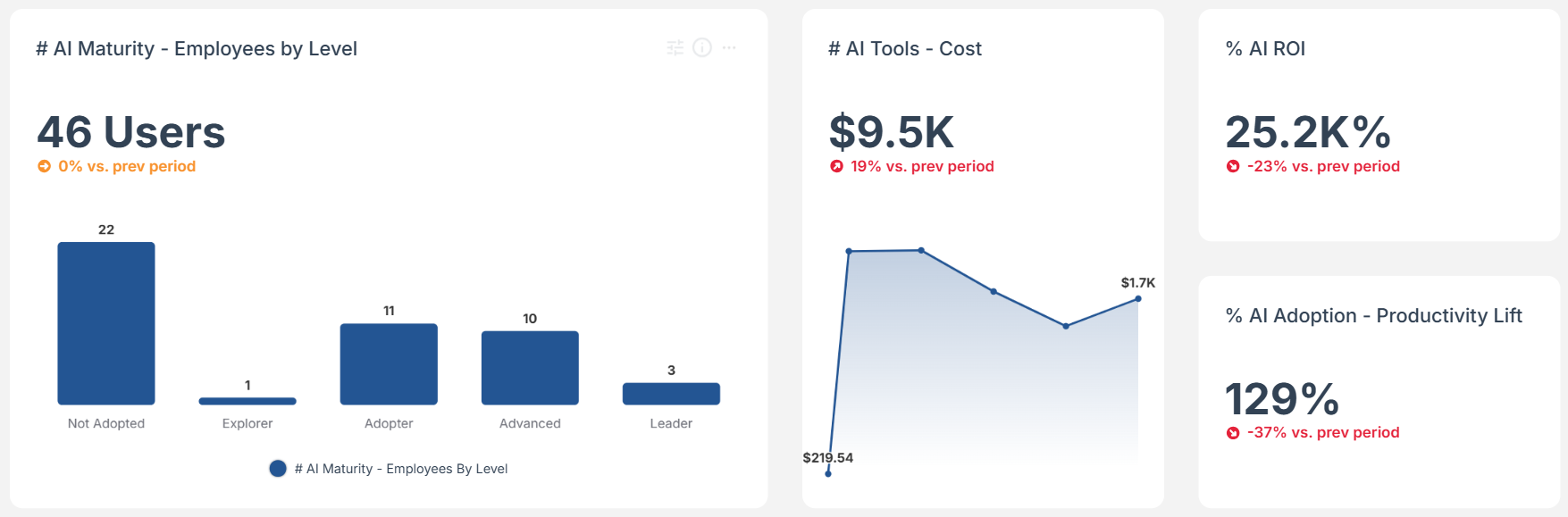
We combine data across the organization, create an enriched company context, understand the relationships between systems and outcomes, and allow the metrics themselves to be deeply customized to the business.
The definitions are open.
The logic can be inspected.
The assumptions can be challenged.
The model can be customized.
The data can be independently validated.
And the resulting metrics can be continuously tested against what is actually happening in the organization.
That is the capability we don't see anywhere else in the market today.
Others can give you a predefined AI adoption score.
Or a developer productivity score.
Or a customer health score.
Or a project risk score.
TargetBoard is built to answer the much harder question:
What should this metric mean for your company, based on your data, your priorities, your definitions, and the decisions you are trying to make?
That distinction becomes more important as metrics become more consequential.
As companies become increasingly data-driven — and increasingly AI-driven — they will create more scores, forecasts, models, agents, and automated recommendations.
The answer cannot be to keep adding simplified metrics on top of fragmented data.
The measurement layer itself has to become smarter.
Metrics need to be:
That is the philosophy behind the new AI Maturity and AI ROI metrics we are releasing at TargetBoard.
But it is also much bigger than these two metrics.
It is a different way of thinking about how an enterprise measures itself.
Because the purpose of a metric is not to produce a number.
It is to create a reliable enough representation of reality that you can confidently make decisions from it.
Anything less can be dangerous.
And that is exactly why we built TargetBoard.ai .

.webp)