.png)

Quick Answer: Platform engineering is the discipline of designing and building self-service workflows to minimize cognitive load for developers.
At its core, an internal developer platform provides:
This approach allows stream-aligned teams to ship code faster without managing underlying operational complexities.
Engineering departments often confuse these roles, and defining clear boundaries is critical for resource allocation. Platform engineers build the paved roads, and DevOps philosophies influence how those roads operate. Without a dedicated platform team, developers often get stuck managing shadow operations instead of writing product code.
Treating the internal developer platform as a mandatory IT project often leads to poor adoption. The Platform as a Product mindset shifts this approach by treating developers as actual customers. Key characteristics include:
The demand for the platform engineering discipline has surged because organizations are struggling to manage the AI impact on software delivery. Developers use artificial intelligence to generate massive volumes of code rapidly, so raw output metrics look incredibly high. But this AI-generated code often introduces hidden complexity and technical debt into the codebase.
Reviewers are forced to spend days validating auto-generated logic. This creates massive workflow friction where code writing is fast but merging is painfully slow. Platform engineering teams are now essential for building the guardrails needed to manage this code surge without sacrificing delivery predictability.
When developers submit highly complex pull requests generated by artificial intelligence, human reviewers can't process them efficiently. This mismatch causes severe workflow bottlenecks that directly inflate cycle time. Pull request churn increases as reviewers request continuous changes to understand the automated logic.
This rework and duplication stall progress across the entire department. When one stream-aligned team gets stuck in an endless review cycle, cross-team dependencies break down. You can't forecast delivery timelines accurately when massive code outputs sit unmerged in fragmented systems.
Platform engineering directly shapes software delivery performance by removing the operational hurdles that slow teams down. A well-designed platform improves execution predictability by:
Golden paths are highly opinionated, supported approaches for building and deploying software. By standardizing these paved roads, platform teams achieve specific outcomes:
Security checks often act as a massive roadblock right before a product launch. Relying on manual approvals and traditional ticket ops forces developers to wait days for a security review, and this actively delays critical releases. Platform engineering solves this by embedding security and compliance guardrails directly into Continuous Integration and Continuous Deployment pipelines.
Developers receive immediate feedback on vulnerabilities while they are still writing code. This shifts security left and eliminates the late-stage friction that frustrates stream-aligned teams.
To evaluate delivery tradeoffs and manage resource allocation effectively, engineering leaders rely on a structured approach to building platforms. According to the Cloud Native Computing Foundation (CNCF) framework, a robust platform requires specific functional areas to operate smoothly^1. These six pillars form the foundation of a predictable delivery system.
A self-service portal provides a single interface for developers to access tools and documentation without filing IT tickets. This centralization reduces context switching so teams can ship features faster.
This pillar automates the setup of cloud resources and deployment environments. You must clearly delineate between basic infrastructure orchestration, which just spins up servers, and advanced operational intelligence, which monitors how efficiently those systems support delivery.
Standardized pipelines govern how code moves from a local commit to a production deployment. Platform teams build these automated routes to ensure every stream-aligned team follows the same reliable path to production.
Automated security checks run in the background to prevent vulnerable code from advancing. This eliminates the need for manual security reviews right before a critical launch.
Observability tools provide real-time visibility into application health and infrastructure performance. If a deployment causes an issue, the platform automatically flags the root cause so developers can resolve it immediately.
Platform teams must track adoption rates and identify workflow bottlenecks to continuously improve the platform. This data proves whether the internal developer platform is actually reducing friction or just shifting the burden to a different system.
Problem: CTOs and engineering leaders often rely on subjective developer surveys or standard engineering metrics to gauge success. These metrics provide useful signals, but they fail to explain why performance is changing or where hidden workflow bottlenecks live within data silos.
Solution: You need an operational intelligence layer to connect fragmented data and track the actual business impact of your platform. TargetBoard is an agentic operational intelligence platform that helps leadership teams understand how execution is performing, why it is changing, and how to respond.
It connects data across company systems and uses domain-expert artificial intelligence agents to guide execution decisions. Instead of looking at a static dashboard showing an unexplained drop in velocity, TargetBoard surfaces the exact workflow friction causing the delay so you can act immediately and improve system-level visibility.
Tracking engineering effectiveness requires a mix of output metrics and deep execution signals. You must measure how fast work moves and understand the context behind those movements to drive predictable delivery outcomes.
Standard DevOps Research and Assessment frameworks measure critical aspects of software delivery performance. They are excellent supporting signals for your organization. But they don't provide system-level visibility into why a team missed a deadline or why a specific repository is suddenly generating massive technical debt.
Consider the edge case where auto-generated code introduces hidden structural complexity. Standard delivery metrics entirely miss this technical debt until it causes a production incident months later. To truly measure engineering effectiveness, you must transition to operational intelligence that connects signals across planning, code, and delivery systems.
According to Gartner research, most software engineering organizations will establish platform engineering teams by 2026^2. But the platform engineering discipline requires internal cultural shifts and disciplined adoption. It's never just about purchasing software and hoping for a productivity spike.
Referencing Team Topologies provides a strong structural foundation for designing successful platform teams that interact smoothly with the rest of your engineering department^3. When you combine a well-structured platform team with proactive operational intelligence, you stop reacting to stale data. You gain the execution predictability needed to lead with complete confidence.

.png)
Lead time for changes is the amount of time it takes a commit to get into production. As a core DORA metric used to evaluate software delivery performance and CI/CD pipeline efficiency, it tracks three specific phases:
That's the mathematical calculation, but the operational reality is very different. When you track change lead time, you aren't actually measuring developer productivity or how fast your team types. You're measuring how long your code sits still. A high lead time signals deep workflow friction across your teams, exposing the hidden waiting states in your delivery process.
Code spends the vast majority of its lifecycle waiting for a human to review it or coordinate its release. If your lead time to deploy is increasing, your organization is suffering from review congestion and organizational friction. The bottleneck is your queueing system, so you have to look at your waiting states to find the real problem.
Engineering leaders often see conflicting signals across disconnected systems because teams use these terms interchangeably. You need precise boundaries to diagnose where work actually gets stuck.
If your cycle time is stable but your DORA metric is expanding, your developers are not the problem. Your deployment coordination and review queues are failing to keep up with the output.
The DORA research program provides clear benchmarks for this metric, categorizing software delivery performance into four tiers:
These benchmarks are useful for setting a baseline, but they don't tell you how to improve. Traditional engineering organizations try to hit the elite tier by pushing developers to work faster. This approach completely ignores how flow systems actually behave.
Elite teams don't type faster. They systematically reduce waiting queues through batch size reduction and automated testing. They understand that a large queue size directly predicts a delivery predictability collapse.
When you push more code into a congested system, you don't get faster delivery. You get massive PR saturation. The code sits in review queues for days, forcing developers to context-switch to new tasks. This destroys momentum and inflates your metrics. Achieving elite performance requires you to manage your bottlenecks and reduce handoff friction, so you must focus on your coordination capacity rather than your raw coding speed.
When looking at a slow pipeline, executives assume developers are struggling with technical problems. The reality is that code spends most of its life in waiting systems. Systemic bottlenecks rarely happen during active development. They happen when work stops moving and enters workflow queues. A high lead time is a symptom of organizational friction, so you have to look at the spaces between your developers to find the real delays.
Every time a piece of code changes hands, it loses momentum. This handoff friction is a primary driver of expanding lead times. A developer finishes a feature and requests a review, but the reviewer is busy with their own sprint commitments. The code sits idle, which introduces coordination latency into the system.
These process bottlenecks compound across teams. Queueing-system dynamics dictate that as utilization approaches 100 percent, wait times increase exponentially. Pushing your teams to maximum capacity actually creates deployment coordination failures and slows everything down.
Artificial intelligence coding assistants have fundamentally changed how work is produced. Developers can now generate massive amounts of code in minutes. But this surge in artificial intelligence code generation creates a dangerous trap. The raw output increases, yet the human capacity to verify that code remains exactly the same.
This imbalance leads directly to review saturation. Complex pull requests (PRs) stack up, extending the code review cycle by days. Reviewers struggle to untangle the sudden influx of code complexity, so they delay the review or rubber-stamp it.
This review congestion forces developers to context-switch while waiting for approvals. That destroys efficiency, inflates your lead time, and ultimately worsens your time to restore service / MTTR when bad code slips through.
Tracking DORA metrics gives you a trailing signal of your performance. But metrics alone cannot explain why performance is changing. When executives rely on manual reporting, they waste hours aggregating fragmented data from Jira and GitHub. The numbers often conflict, which erodes trust in the data and creates massive engineering overhead. A high lead time signals deep workflow friction across your teams.
To actually solve these delays, you have to understand the bottleneck economics of your delivery pipeline. You need a single source of truth that connects disconnected systems and exposes hidden waiting states. This is why engineering leaders are moving away from passive manual reporting and shifting toward operational intelligence, enabling true data-driven decision making.
You can't solve a delivery slowdown by forcing your team to write code faster. Software delivery is fundamentally constrained by human coordination capacity. According to the foundational Accelerate research, organizations must optimize the entire value stream. As AI accelerates code generation, it pushes organizations up against strict human verification limits. If your review queues can't handle the volume, your lead time to deploy will inevitably increase.
Ignoring queueing-system dynamics creates severe maintainability risks. Code that sits in congested pipelines degrades in quality, and developers lose the context needed to fix it, leading to a massive accumulation of technical debt. Restoring predictability requires you to manage your workflow queues actively. You must align your output with your capacity to review, verify, and coordinate that work.

Software development performance metrics are operational signals that measure how efficiently a team delivers code to production. The industry standard baseline relies on the four core DevOps Research and Assessment metrics. These engineering Key Performance Indicators divide performance into speed and stability.
VPs of Engineering often fall into a scoreboard mentality when tracking these numbers. They spend hours manually aggregating point-in-time reports, treating the metrics as the final goal rather than a diagnostic signal. Improving these software delivery performance metrics requires understanding the workflow friction beneath the numbers. Frameworks provide signals, so they don't provide full understanding on their own. You must connect these signals to actual execution decisions to improve delivery predictability.
Problem: Teams ship features slowly and can't pinpoint where work gets stuck in the pipeline.
Solution: Measure cycle time to identify bottlenecks in the review and deployment phases.
Artificial intelligence code generation fundamentally changes how software is built. Tools like Copilot and Cursor allow developers to write thousands of lines of code in minutes. And this massive increase in raw throughput completely breaks traditional software developer productivity metrics.
You look at your dashboards and see record-high commit volumes. The metrics suggest the team is moving faster than ever, yet overall delivery predictability drops. This happens because increased output actively masks hidden complexity. AI tools generate code quickly, but that code often lacks systemic context. The resulting codebase becomes brittle, and the organization accumulates technical debt faster than human developers can refactor it.
Quantitative data only tells half the story, so engineering leaders must also track qualitative metrics to understand the reality on the ground. Frameworks like the SPACE framework provide a more balanced view by combining qualitative and quantitative data. This approach prevents leaders from optimizing a system to the point of breaking the people running it.
You can't measure system health without measuring Developer Experience. High workflow friction directly degrades how developers feel about their work. When developers constantly fight broken pipelines or wait days for code reviews, their satisfaction plummets and delivery slows down.
Problem: Teams take on too many tasks at once, so context switching destroys their focus and stalls delivery.
Solution: Implement work in progress limits to force completion before starting new tasks and increase delivery confidence.
Enterprise engineering teams still rely on outdated measurement tactics that incentivize the wrong behaviors. Measuring the wrong things creates a toxic culture and actively hides systemic risks.
Tracking lines of code is the fastest way to destroy developer effectiveness. This metric was always flawed, but Artificial Intelligence makes it actively dangerous. AI tools can generate thousands of lines of boilerplate code in seconds. If you measure volume, your metrics will look incredible while your codebase becomes an unmaintainable mess. You need to measure the value delivered to the customer instead of the raw output.
Software development is a complex team operation. Tracking team performance vs. individual performance is a critical distinction. Pitting developers against each other creates a toxic environment where senior engineers refuse to help juniors. If a lead engineer spends all week reviewing pull requests, their individual commit metrics will drop. Yet their work is exactly what keeps the entire system moving. You must measure how the team delivers as a unified unit.
Executives often demand faster delivery without understanding the speed vs. quality tradeoffs. Pushing teams to ship faster without investing in automated testing leads to a massive spike in production failures. The system will eventually grind to a halt under the weight of its own technical debt. True predictability requires balancing feature development with continuous system maintenance.
Dashboard fatigue is a very real problem for modern engineering leaders. You have a Jira dashboard for issue tracking and a GitHub dashboard for pull requests. These Jira and GitHub data silos provide conflicting signals. Jira says the sprint was successful, but GitHub shows massive code review churn.
This disconnect forces leaders to rely on intuition rather than data. You can't make confident execution decisions when your tools refuse to talk to each other. Dashboards are static scoreboards that show you what happened yesterday. They don't tell you why it happened or what you should do about it today.
TargetBoard is an agentic operational intelligence platform that helps leadership teams understand how execution is performing, why it is changing, and how to respond. It unifies performance data across systems into a trusted model and deploys domain-expert AI agents to translate insights into decision-ready inputs that guide execution.
Tracking software development performance metrics isn't the end goal. The goal is to build a reliable delivery system that consistently drives business outcomes. Staring at a static scoreboard won't help you identify the hidden complexity introduced by Artificial Intelligence or the workflow friction slowing down your senior engineers.
You must shift your focus from measuring isolated outputs to understanding your interconnected systems. This systemic visibility gives you a clear framework for your next resource allocation discussion or board meeting. It replaces guesswork with actual delivery predictability. Take a hard look at your current reporting structure and ask yourself if your data actually helps you make better execution decisions, because visibility without action is just overhead. If it just gives you another number to report, it's time to upgrade your operational intelligence.
Development cycle time is the total amount of time it takes for an engineering team to complete a single task from the moment work begins until it is deployed to production.
This metric originated in Lean manufacturing to measure inventory flow. Today it serves as a critical diagnostic signal for software development cycle time. Traditional engineering leaders often make the mistake of treating this as a pure speed metric. I have watched organizations gamify cycle time to push developers to type faster. That approach inevitably leads to developer burnout and lower quality code. A low cycle time means nothing if the code requires massive rework later.
You must view development cycle time as a measure of system flow and cross-team friction. It tells you exactly where work stalls. Tracking this accurately is the only way to ensure delivery predictability across your entire engineering organization.
The difference between cycle time and lead time comes down to when the clock starts. Lead time begins the moment a customer requests a feature, while cycle time begins the moment a developer actually starts writing code for that feature.
Lead time for changes measures your entire product management and prioritization process. Software cycle time isolates the engineering execution phase. You need both to understand your true time to market.
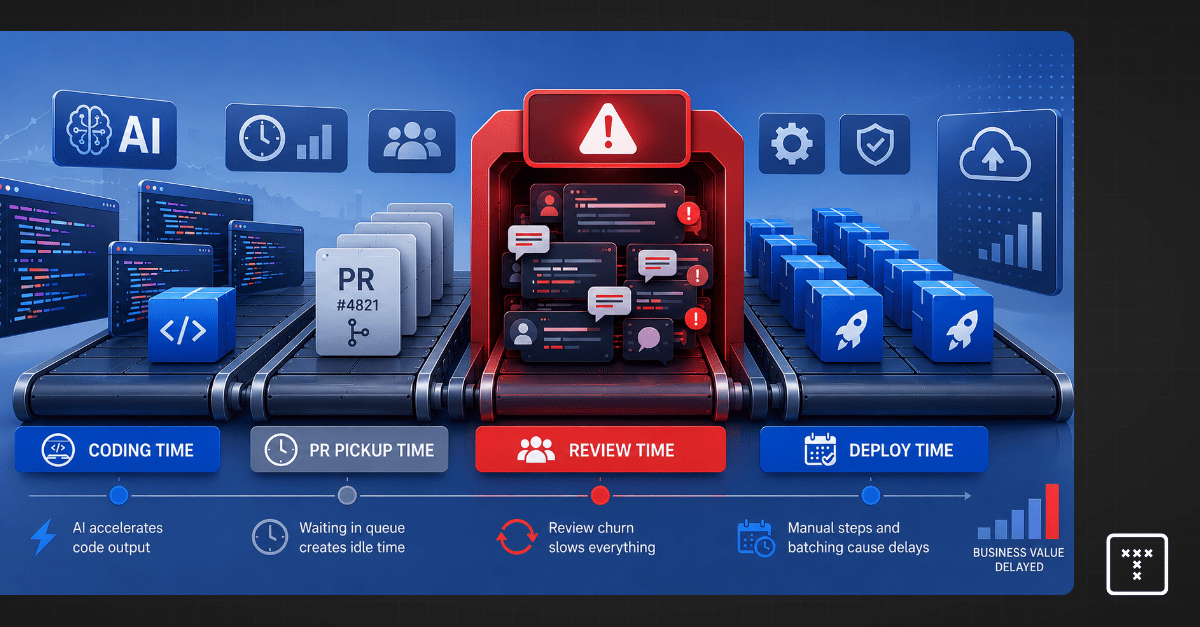
You can't fix a bottleneck until you know exactly where it lives. The cycle time formula breaks down into four distinct phases. Tracking the transition between these phases reveals where your system loses momentum.
Coding time measures the lifespan from the developer's first commit to the moment they issue a pull request. This phase tracks active creation. AI tools have drastically reduced coding time across the industry.
PR pickup time tracks the idle period between a developer opening a pull request and a peer beginning the review. That's rarely a skill issue. It's almost always a coordination and visibility problem.
Review time measures the span from the first review comment to the final approval. That's the most common bottleneck in modern software delivery. Fast coding times often hide severe inefficiencies here, as reviewers struggle to understand massive blocks of undocumented code.
Deploy time covers the final span from a code merger to a production release. Heavy manual testing requirements and complex release train schedules often inflate this metric, leaving finished code sitting idle.
To measure development cycle time accurately, you must connect your issue tracking software to your version control system to track the exact timestamps of commits, pull requests, reviews, and deployments.
Relying solely on DORA metrics or isolated Jira boards gives you an incomplete picture. DORA metrics provide useful signals for deployment frequency and stability, but they do not provide system-level visibility into why a specific workflow is stalling. Fragmented tools make measurement incredibly difficult. Jira says a ticket is in progress, but GitHub shows the code has been sitting in review for four days. You can't manually merge this data to calculate accurate sprint velocity. You need a unified operational model to see the truth.
You must standardize your data inputs before you can diagnose your delivery pipelines. Follow these steps to build a reliable measurement foundation.
Connecting these steps gives you actionable insights to improve workflow efficiency and continuous delivery.
When you push teams to just code faster, you fall into the local optimization trap. A local optimization improves one small part of the process while degrading the whole system. Forcing engineers to close tickets rapidly often leads to sloppy commits, so you see a massive spike in rework and code churn during the review phase. This creates a severe downstream delivery impact. You must measure system flow outcomes rather than isolated speed metrics to protect your delivery timelines.
I see this constantly with modern engineering teams. You roll out AI coding assistants, and coding time drops to near zero. Developers produce massive blocks of code in minutes. Management often views these tools purely as cycle time accelerators, but they fail to account for the resulting review churn.
AI-assisted developers write code up to 50% faster, yet PR cycle times often increase due to the cognitive load placed on reviewers.¹ AI-generated code introduces hidden complexity, so reviewers have to spend hours untangling logic they didn't write. This creates a massive delivery bottleneck and severe maintainability risks. You accelerated the easiest part of the job while gridlocking the hardest part.
Engineering leaders often mandate a smaller pull request size to speed up reviews. This sounds logical in theory. In reality, forcing developers to break a single feature into ten tiny PRs creates a coordination nightmare. Reviewers lose the broader context, so defect patterns increase during integration. That's especially true when working with highly complex, interdependent legacy codebases that skew standard benchmarks.
Your agile cycle time might look great on a dashboard, but your actual system flow grinds to a halt. You must enforce strict Work In Progress (WIP) limits to balance batch size with the cognitive load required to review the entire feature.
True optimization comes from lean manufacturing principles. You don't ask the assembly line workers to move their hands faster. You eliminate the wait time and idle time between stations.
In software delivery, this means reducing handoffs and automating your deployment frequency. You want work to flow continuously without sitting in a queue waiting for manual intervention. Elite performers achieve high deployment frequency by minimizing handoffs rather than pushing individual engineers to type faster.²
Use this framework to find the root cause of your delivery delays and fix your workflow coordination.
Having a dashboard that tells you your cycle time is nine days doesn't help you fix it. Passive metrics require you to guess what went wrong. You need operational intelligence to explain why performance is changing. This requires shifting from basic executive reporting to an agentic system that understands delivery trade-offs and system flow.
TargetBoard is an agentic operational intelligence platform that helps leadership teams understand how execution is performing, why it's changing, and how to respond. TargetBoard deploys domain-expert AI agents across your connected systems to act as expert analysts. Instead of just showing a red line on a graph, TargetBoard explains that cycle time spiked because AI-generated code in a specific repository caused a 40% increase in review churn. It translates raw data into objective signals you can use to make immediate resource decisions.
Pushing for speed without predictability is an organizational failure. Keep in mind that no single metric provides a complete picture of engineering health. True engineering velocity requires reliable system flow. When you stop treating development cycle time as a stopwatch and start treating it as a diagnostic signal, you regain delivery predictability. Understanding these patterns gives you a clear framework to align your engineering execution with your business goals and confidently forecast your next major release.

.webp)