All Posts

Software Development Performance Metrics

gradient background

Software Development Performance Metrics: Moving From Scoreboards to Systemic Intelligence

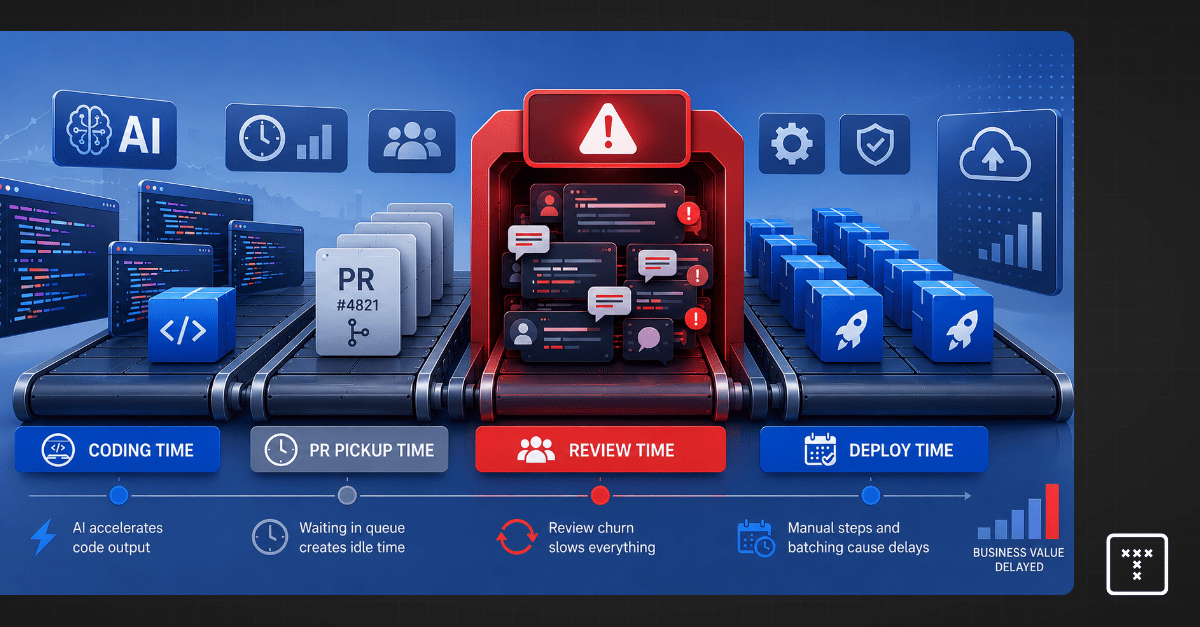
You sit down to prepare for the board meeting, pulling Jira ticket velocity on one monitor and GitHub merge times on the other. The numbers completely contradict each other. Jira shows a record-breaking sprint, yet your GitHub data reveals pull requests sitting in review for four days. You see the metrics shift, but you can't confidently explain why delivery is actually slowing down. That lack of understanding forces you to rely on guesswork, which destroys delivery predictability and erodes trust with the C-suite. Traditional software development performance metrics treat delivery like a disconnected scoreboard. Improving individual metrics on a dashboard does not guarantee overall performance improvement. Performance is actually an interconnected system. Managing fragmented tools prevents leaders from understanding where execution is breaking down. This gap widens as Artificial Intelligence coding tools accelerate raw output while hiding underlying complexity. Organizations have strong systems for measuring performance, so they must now build systems for interpreting it. You don't just need to measure engineering performance. You need to explain why it's changing.

Key Takeaways

check mark in box icon
Metrics are signals, not answers. Tracking isolated data points is useless if you can't identify the cross-team dependencies causing delays.
check mark in box icon
Artificial Intelligence breaks traditional measurement. AI code generation increases raw throughput but heavily masks hidden complexity and massive pull request bottlenecks.
check mark in box icon
Dashboards create a false sense of security. A scoreboard mentality forces leaders to rely on guesswork because disconnected tools provide conflicting data.
check mark in box icon
Systemic visibility drives execution. Connecting code quality, workflow behavior, and delivery metrics allows teams to catch delivery risk before it gets merged.

What Are Software Performance Metrics? The Four Core DevOps Research and Assessment Metrics

Software development performance metrics are operational signals that measure how efficiently a team delivers code to production. The industry standard baseline relies on the four core DevOps Research and Assessment metrics. These engineering Key Performance Indicators divide performance into speed and stability.

VPs of Engineering often fall into a scoreboard mentality when tracking these numbers. They spend hours manually aggregating point-in-time reports, treating the metrics as the final goal rather than a diagnostic signal. Improving these software delivery performance metrics requires understanding the workflow friction beneath the numbers. Frameworks provide signals, so they don't provide full understanding on their own. You must connect these signals to actual execution decisions to improve delivery predictability.

#1. Cycle Time

Problem: Teams ship features slowly and can't pinpoint where work gets stuck in the pipeline.

Solution: Measure cycle time to identify bottlenecks in the review and deployment phases.

  • Cycle time measures the total time elapsed from the moment a developer commits code to the moment that code reaches production.
  • Elite benchmark: Top-performing teams maintain a cycle time of less than 26 hours.
  • Core driver: A high cycle time usually indicates massive pull requests or heavy cross-team dependencies.
  • Execution focus: Teams must balance throughput vs. instability by breaking work down into smaller increments.

#2. Deployment Frequency

  • Deployment frequency tracks how often an engineering team successfully releases code to production.
  • Elite benchmark: Elite performing teams deploy multiple times per day.
  • Frequent deployments require highly automated testing pipelines, making this one of the most critical software developer metrics.
  • Execution focus: High deployment frequency reduces the risk of massive release failures and forces teams to work in small batches.

#3. Change Failure Rate

  • Change failure rate measures the percentage of deployments that cause a failure in production requiring immediate remediation.
  • Elite benchmark: The elite benchmark for change failure rate sits between 0% and 15%.
  • This metric acts as a critical counterweight to deployment frequency.
  • Execution focus: A rising change failure rate signals unmitigated delivery risk, meaning the team is sacrificing quality for speed.

#4.  Mean Time To Recovery

  • Mean time to recovery tracks how long it takes an organization to restore service after a production failure occurs.
  • Elite benchmark: Elite teams achieve a mean time to recovery of less than one hour.
  • Failures are inevitable in complex systems, making this a vital software delivery performance metric.
  • Execution focus: Fast recovery times indicate strong observability practices and resilient system architecture.

The Artificial Intelligence Systemic Breakdown: How Increased Output Masks Hidden Complexity

Artificial intelligence code generation fundamentally changes how software is built. Tools like Copilot and Cursor allow developers to write thousands of lines of code in minutes. And this massive increase in raw throughput completely breaks traditional software developer productivity metrics.

You look at your dashboards and see record-high commit volumes. The metrics suggest the team is moving faster than ever, yet overall delivery predictability drops. This happens because increased output actively masks hidden complexity. AI tools generate code quickly, but that code often lacks systemic context. The resulting codebase becomes brittle, and the organization accumulates technical debt faster than human developers can refactor it.

Pull Request Bottlenecks: When High Volume Meets Human Limits

  • The volume problem: Artificial Intelligence generates massive blocks of code, so pull request size and review time explode.
  • The human limit: Human reviewers simply can't process this high volume of generated code at the same speed it's created.
  • Workflow friction: Work piles up in the review stage, and developers spend days waiting for approvals.
  • Code review churn: Reviewers face extreme cognitive overload, so subjective review decisions become inconsistent. They either rubber-stamp complex pull requests without proper scrutiny or block them indefinitely out of caution.

Tracking Defect Density and Long-Term Technical Debt

  • The quality gap: Fast code generation often results in poor long-term maintainability.
  • Defect density tracks the number of confirmed bugs relative to the size of the software module.
  • The AI flaw: AI-generated code frequently contains subtle logical flaws that bypass automated tests, so defect density rises steadily over time.
  • Engineering investment: Teams spend less time building new features and more time keeping the lights on. Maintainability trends downward as the codebase becomes more complex.

Qualitative Metrics: Developer Experience and Flow

Quantitative data only tells half the story, so engineering leaders must also track qualitative metrics to understand the reality on the ground. Frameworks like the SPACE framework provide a more balanced view by combining qualitative and quantitative data. This approach prevents leaders from optimizing a system to the point of breaking the people running it.

You can't measure system health without measuring Developer Experience. High workflow friction directly degrades how developers feel about their work. When developers constantly fight broken pipelines or wait days for code reviews, their satisfaction plummets and delivery slows down.

  • Satisfaction and well-being: Track how developers feel about their tools and processes through regular surveys to prevent burnout.
  • Measure the actual performance outcomes of the software delivered rather than just the volume of output, since raw volume rarely correlates with business value.
  • Monitor activity in the design and coding phases to understand where developers actually spend their time.
  • Communication and collaboration: Evaluate how easily teams share knowledge and review each other's work across the organization, because siloed information directly inflates cycle time.
  • Efficiency and flow: Track the ability of developers to stay in a state of deep work without facing constant pipeline interruptions, which ultimately dictates their true productivity.

Implementing Work In Progress Limits and Team Goal Alignment

Problem: Teams take on too many tasks at once, so context switching destroys their focus and stalls delivery.

Solution: Implement work in progress limits to force completion before starting new tasks and increase delivery confidence.

  1. Identify the bottleneck: Map your current workflow to find exactly where tickets pile up. This usually happens in the code review or QA testing phases.
  2. Set strict constraints: Cap the number of active tickets allowed in that specific workflow state so developers are forced to finish existing tasks before starting new ones. If the limit is three, developers can't move a fourth ticket into that column.
  3. Force team swarming: Require developers to help unblock stuck tickets before they pull new work from the backlog. This aligns team behavior with overall delivery goals rather than individual task completion.
  4. Adjust continuously: Review these limits during retrospectives and tackle the underlying workflow friction causing the pileup, which prevents the same bottlenecks from recurring next sprint.

Three Outdated Anti-Patterns to Avoid When Measuring Engineering KPIs

Enterprise engineering teams still rely on outdated measurement tactics that incentivize the wrong behaviors. Measuring the wrong things creates a toxic culture and actively hides systemic risks.

Anti-Pattern The Problem The TargetBoard Solution
Tracking output volume Developers optimize for lines of code rather than solving the actual business problem. TargetBoard measures system efficiency and workflow bottlenecks instead of raw code volume.
Pitting developers against each other Tracking individual performance destroys collaboration and incentivizes developers to hoard easy tasks. TargetBoard analyzes cross-team dependencies and shared workflow friction to improve overall system health.
Ignoring technical debt Teams push features fast but accumulate massive maintenance costs that slow future development. TargetBoard acts as an agentic operational intelligence layer to detect AI-induced complexity before it reaches production.

Anti-Pattern One: Measuring Lines of Code

Tracking lines of code is the fastest way to destroy developer effectiveness. This metric was always flawed, but Artificial Intelligence makes it actively dangerous. AI tools can generate thousands of lines of boilerplate code in seconds. If you measure volume, your metrics will look incredible while your codebase becomes an unmaintainable mess. You need to measure the value delivered to the customer instead of the raw output.

Anti-Pattern Two: Tracking Individual Instead of Team Performance

Software development is a complex team operation. Tracking team performance vs. individual performance is a critical distinction. Pitting developers against each other creates a toxic environment where senior engineers refuse to help juniors. If a lead engineer spends all week reviewing pull requests, their individual commit metrics will drop. Yet their work is exactly what keeps the entire system moving. You must measure how the team delivers as a unified unit.

Anti-Pattern Three: Sacrificing Quality for Speed

Executives often demand faster delivery without understanding the speed vs. quality tradeoffs. Pushing teams to ship faster without investing in automated testing leads to a massive spike in production failures. The system will eventually grind to a halt under the weight of its own technical debt. True predictability requires balancing feature development with continuous system maintenance.

Why Dashboards Fail: Moving from Scoreboards to Systemic Intelligence

Dashboard fatigue is a very real problem for modern engineering leaders. You have a Jira dashboard for issue tracking and a GitHub dashboard for pull requests. These Jira and GitHub data silos provide conflicting signals. Jira says the sprint was successful, but GitHub shows massive code review churn.

This disconnect forces leaders to rely on intuition rather than data. You can't make confident execution decisions when your tools refuse to talk to each other. Dashboards are static scoreboards that show you what happened yesterday. They don't tell you why it happened or what you should do about it today.

TargetBoard is an agentic operational intelligence platform that helps leadership teams understand how execution is performing, why it is changing, and how to respond. It unifies performance data across systems into a trusted model and deploys domain-expert AI agents to translate insights into decision-ready inputs that guide execution.

Feature Old Way (Dashboards) New Way (Agentic Intelligence)
Data Integration Fragmented Jira and GitHub data silos require manual exports. Unified operational model connects planning, code, and delivery automatically.
Analysis Static charts force leaders to guess why metrics are changing. Domain-expert AI agents explain exactly why performance shifted.
AI Impact Blind to the difference between human and AI-generated code. Exposes how AI code generation impacts review time and system complexity.
Outcome Dashboard fatigue and delayed reactions to delivery risks. Confident execution decisions based on real-time systemic visibility.

Stop Tracking Metrics, Start Understanding Your Delivery System

Tracking software development performance metrics isn't the end goal. The goal is to build a reliable delivery system that consistently drives business outcomes. Staring at a static scoreboard won't help you identify the hidden complexity introduced by Artificial Intelligence or the workflow friction slowing down your senior engineers.

You must shift your focus from measuring isolated outputs to understanding your interconnected systems. This systemic visibility gives you a clear framework for your next resource allocation discussion or board meeting. It replaces guesswork with actual delivery predictability. Take a hard look at your current reporting structure and ask yourself if your data actually helps you make better execution decisions, because visibility without action is just overhead. If it just gives you another number to report, it's time to upgrade your operational intelligence.

See how this works in TargetBoard

Watch this short demo video
Get a personalized demo

FAQs

Related Posts

gradient background
Best Practice

Software Development Performance Metrics

You sit down to prepare for the board meeting, pulling Jira ticket velocity on one monitor and GitHub merge times on the other. The numbers completely contradict each other. Jira shows a record-breaking sprint, yet your GitHub data reveals pull requests sitting in review for four days. You see the metrics shift, but you can't confidently explain why delivery is actually slowing down. That lack of understanding forces you to rely on guesswork, which destroys delivery predictability and erodes trust with the C-suite. Traditional software development performance metrics treat delivery like a disconnected scoreboard. Improving individual metrics on a dashboard does not guarantee overall performance improvement. Performance is actually an interconnected system. Managing fragmented tools prevents leaders from understanding where execution is breaking down. This gap widens as Artificial Intelligence coding tools accelerate raw output while hiding underlying complexity. Organizations have strong systems for measuring performance, so they must now build systems for interpreting it. You don't just need to measure engineering performance. You need to explain why it's changing.
May 10, 2026
5 min read

What Are Software Performance Metrics? The Four Core DevOps Research and Assessment Metrics

Software development performance metrics are operational signals that measure how efficiently a team delivers code to production. The industry standard baseline relies on the four core DevOps Research and Assessment metrics. These engineering Key Performance Indicators divide performance into speed and stability.

VPs of Engineering often fall into a scoreboard mentality when tracking these numbers. They spend hours manually aggregating point-in-time reports, treating the metrics as the final goal rather than a diagnostic signal. Improving these software delivery performance metrics requires understanding the workflow friction beneath the numbers. Frameworks provide signals, so they don't provide full understanding on their own. You must connect these signals to actual execution decisions to improve delivery predictability.

#1. Cycle Time

Problem: Teams ship features slowly and can't pinpoint where work gets stuck in the pipeline.

Solution: Measure cycle time to identify bottlenecks in the review and deployment phases.

  • Cycle time measures the total time elapsed from the moment a developer commits code to the moment that code reaches production.
  • Elite benchmark: Top-performing teams maintain a cycle time of less than 26 hours.
  • Core driver: A high cycle time usually indicates massive pull requests or heavy cross-team dependencies.
  • Execution focus: Teams must balance throughput vs. instability by breaking work down into smaller increments.

#2. Deployment Frequency

  • Deployment frequency tracks how often an engineering team successfully releases code to production.
  • Elite benchmark: Elite performing teams deploy multiple times per day.
  • Frequent deployments require highly automated testing pipelines, making this one of the most critical software developer metrics.
  • Execution focus: High deployment frequency reduces the risk of massive release failures and forces teams to work in small batches.

#3. Change Failure Rate

  • Change failure rate measures the percentage of deployments that cause a failure in production requiring immediate remediation.
  • Elite benchmark: The elite benchmark for change failure rate sits between 0% and 15%.
  • This metric acts as a critical counterweight to deployment frequency.
  • Execution focus: A rising change failure rate signals unmitigated delivery risk, meaning the team is sacrificing quality for speed.

#4.  Mean Time To Recovery

  • Mean time to recovery tracks how long it takes an organization to restore service after a production failure occurs.
  • Elite benchmark: Elite teams achieve a mean time to recovery of less than one hour.
  • Failures are inevitable in complex systems, making this a vital software delivery performance metric.
  • Execution focus: Fast recovery times indicate strong observability practices and resilient system architecture.

The Artificial Intelligence Systemic Breakdown: How Increased Output Masks Hidden Complexity

Artificial intelligence code generation fundamentally changes how software is built. Tools like Copilot and Cursor allow developers to write thousands of lines of code in minutes. And this massive increase in raw throughput completely breaks traditional software developer productivity metrics.

You look at your dashboards and see record-high commit volumes. The metrics suggest the team is moving faster than ever, yet overall delivery predictability drops. This happens because increased output actively masks hidden complexity. AI tools generate code quickly, but that code often lacks systemic context. The resulting codebase becomes brittle, and the organization accumulates technical debt faster than human developers can refactor it.

Pull Request Bottlenecks: When High Volume Meets Human Limits

  • The volume problem: Artificial Intelligence generates massive blocks of code, so pull request size and review time explode.
  • The human limit: Human reviewers simply can't process this high volume of generated code at the same speed it's created.
  • Workflow friction: Work piles up in the review stage, and developers spend days waiting for approvals.
  • Code review churn: Reviewers face extreme cognitive overload, so subjective review decisions become inconsistent. They either rubber-stamp complex pull requests without proper scrutiny or block them indefinitely out of caution.

Tracking Defect Density and Long-Term Technical Debt

  • The quality gap: Fast code generation often results in poor long-term maintainability.
  • Defect density tracks the number of confirmed bugs relative to the size of the software module.
  • The AI flaw: AI-generated code frequently contains subtle logical flaws that bypass automated tests, so defect density rises steadily over time.
  • Engineering investment: Teams spend less time building new features and more time keeping the lights on. Maintainability trends downward as the codebase becomes more complex.

Qualitative Metrics: Developer Experience and Flow

Quantitative data only tells half the story, so engineering leaders must also track qualitative metrics to understand the reality on the ground. Frameworks like the SPACE framework provide a more balanced view by combining qualitative and quantitative data. This approach prevents leaders from optimizing a system to the point of breaking the people running it.

You can't measure system health without measuring Developer Experience. High workflow friction directly degrades how developers feel about their work. When developers constantly fight broken pipelines or wait days for code reviews, their satisfaction plummets and delivery slows down.

  • Satisfaction and well-being: Track how developers feel about their tools and processes through regular surveys to prevent burnout.
  • Measure the actual performance outcomes of the software delivered rather than just the volume of output, since raw volume rarely correlates with business value.
  • Monitor activity in the design and coding phases to understand where developers actually spend their time.
  • Communication and collaboration: Evaluate how easily teams share knowledge and review each other's work across the organization, because siloed information directly inflates cycle time.
  • Efficiency and flow: Track the ability of developers to stay in a state of deep work without facing constant pipeline interruptions, which ultimately dictates their true productivity.

Implementing Work In Progress Limits and Team Goal Alignment

Problem: Teams take on too many tasks at once, so context switching destroys their focus and stalls delivery.

Solution: Implement work in progress limits to force completion before starting new tasks and increase delivery confidence.

  1. Identify the bottleneck: Map your current workflow to find exactly where tickets pile up. This usually happens in the code review or QA testing phases.
  2. Set strict constraints: Cap the number of active tickets allowed in that specific workflow state so developers are forced to finish existing tasks before starting new ones. If the limit is three, developers can't move a fourth ticket into that column.
  3. Force team swarming: Require developers to help unblock stuck tickets before they pull new work from the backlog. This aligns team behavior with overall delivery goals rather than individual task completion.
  4. Adjust continuously: Review these limits during retrospectives and tackle the underlying workflow friction causing the pileup, which prevents the same bottlenecks from recurring next sprint.

Three Outdated Anti-Patterns to Avoid When Measuring Engineering KPIs

Enterprise engineering teams still rely on outdated measurement tactics that incentivize the wrong behaviors. Measuring the wrong things creates a toxic culture and actively hides systemic risks.

Anti-Pattern The Problem The TargetBoard Solution
Tracking output volume Developers optimize for lines of code rather than solving the actual business problem. TargetBoard measures system efficiency and workflow bottlenecks instead of raw code volume.
Pitting developers against each other Tracking individual performance destroys collaboration and incentivizes developers to hoard easy tasks. TargetBoard analyzes cross-team dependencies and shared workflow friction to improve overall system health.
Ignoring technical debt Teams push features fast but accumulate massive maintenance costs that slow future development. TargetBoard acts as an agentic operational intelligence layer to detect AI-induced complexity before it reaches production.

Anti-Pattern One: Measuring Lines of Code

Tracking lines of code is the fastest way to destroy developer effectiveness. This metric was always flawed, but Artificial Intelligence makes it actively dangerous. AI tools can generate thousands of lines of boilerplate code in seconds. If you measure volume, your metrics will look incredible while your codebase becomes an unmaintainable mess. You need to measure the value delivered to the customer instead of the raw output.

Anti-Pattern Two: Tracking Individual Instead of Team Performance

Software development is a complex team operation. Tracking team performance vs. individual performance is a critical distinction. Pitting developers against each other creates a toxic environment where senior engineers refuse to help juniors. If a lead engineer spends all week reviewing pull requests, their individual commit metrics will drop. Yet their work is exactly what keeps the entire system moving. You must measure how the team delivers as a unified unit.

Anti-Pattern Three: Sacrificing Quality for Speed

Executives often demand faster delivery without understanding the speed vs. quality tradeoffs. Pushing teams to ship faster without investing in automated testing leads to a massive spike in production failures. The system will eventually grind to a halt under the weight of its own technical debt. True predictability requires balancing feature development with continuous system maintenance.

Why Dashboards Fail: Moving from Scoreboards to Systemic Intelligence

Dashboard fatigue is a very real problem for modern engineering leaders. You have a Jira dashboard for issue tracking and a GitHub dashboard for pull requests. These Jira and GitHub data silos provide conflicting signals. Jira says the sprint was successful, but GitHub shows massive code review churn.

This disconnect forces leaders to rely on intuition rather than data. You can't make confident execution decisions when your tools refuse to talk to each other. Dashboards are static scoreboards that show you what happened yesterday. They don't tell you why it happened or what you should do about it today.

TargetBoard is an agentic operational intelligence platform that helps leadership teams understand how execution is performing, why it is changing, and how to respond. It unifies performance data across systems into a trusted model and deploys domain-expert AI agents to translate insights into decision-ready inputs that guide execution.

Feature Old Way (Dashboards) New Way (Agentic Intelligence)
Data Integration Fragmented Jira and GitHub data silos require manual exports. Unified operational model connects planning, code, and delivery automatically.
Analysis Static charts force leaders to guess why metrics are changing. Domain-expert AI agents explain exactly why performance shifted.
AI Impact Blind to the difference between human and AI-generated code. Exposes how AI code generation impacts review time and system complexity.
Outcome Dashboard fatigue and delayed reactions to delivery risks. Confident execution decisions based on real-time systemic visibility.

Stop Tracking Metrics, Start Understanding Your Delivery System

Tracking software development performance metrics isn't the end goal. The goal is to build a reliable delivery system that consistently drives business outcomes. Staring at a static scoreboard won't help you identify the hidden complexity introduced by Artificial Intelligence or the workflow friction slowing down your senior engineers.

You must shift your focus from measuring isolated outputs to understanding your interconnected systems. This systemic visibility gives you a clear framework for your next resource allocation discussion or board meeting. It replaces guesswork with actual delivery predictability. Take a hard look at your current reporting structure and ask yourself if your data actually helps you make better execution decisions, because visibility without action is just overhead. If it just gives you another number to report, it's time to upgrade your operational intelligence.
Best Practice

Which KPIs for Engineering Teams Actually Drive Execution?

You pull up your Jira dashboard and see a massive spike in cycle time. You check GitHub to investigate, yet the numbers there tell a completely different story. This dashboard fatigue is a daily reality for engineering leaders managing complex software delivery at scale. Organizations have strong systems for measuring performance. They lack a consistent system for interpreting it. The gap is no longer visibility. It's understanding and coordinated decision-making. Leaders can see metrics easily. They just struggle to understand why performance is changing. This disconnect erodes trust in reporting, delays critical decisions, and destroys predictability in execution. We don't just measure engineering performance. We explain why it's changing. Connecting data across your planning, code, and delivery systems is the only way to turn passive numbers into actionable operational intelligence.
May 7, 2026
5 min read

A Look at the 4 Core KPI Categories for Engineering Teams

The best KPI examples for engineering span four core categories that measure speed, efficiency, quality, and system health. Tracking only one category leads to broken systems. Optimizing for speed without monitoring quality will inevitably create technical debt and delivery bottlenecks.

Here are the core engineering metrics you need to track software delivery performance accurately.

1. Speed and Stability (DevOps Research and Assessment Metrics)

Google's DevOps Research and Assessment (DORA) metrics are the baseline industry standard for measuring delivery performance. They focus strictly on how fast you ship and how reliable those shipments are.

  • Deployment frequency: How often your team successfully releases code to production.
  • Lead time for changes: The total time it takes for a commit to reach production.
  • Change failure rate: The percentage of deployments that cause a failure in production requiring immediate remediation.
  • Mean time to restore: How long it takes your team to recover from a failure in production.

2. Productivity and Process Efficiency

Speed metrics tell you when code ships. Efficiency metrics reveal how work flows through your internal systems before deployment.

  • Cycle time: The total duration from when work begins on an issue to when it is delivered.
  • Sprint velocity: The amount of work a team completes during a sprint.
  • Pull request review time: The duration a pull request sits open before being merged.
  • Bottlenecks: The specific stages in your workflow where tickets accumulate and stall.
  • Effort allocation / capacity allocation: The distribution of engineering time across new features, bug fixes, and maintenance to ensure teams are working on the right priorities.

3. Quality and Business Impact

Shipping fast only matters if you ship reliable code that solves customer problems. You must connect engineering output to actual business value.

  • Defect rate: The frequency of bugs found in production compared to the total number of deployments.
  • Customer satisfaction (CSAT) / NPS: How well the delivered software solves user problems, often measured through Net Promoter Scores and direct user feedback.
  • Time to market: The total time required to deliver a new product from initial concept to customer availability.
  • Return on investment: The financial impact and business value generated by the engineering effort.

4. System Health and Developer Experience

A fast team will eventually slow down if the underlying system is fragile. These metrics ensure sustainable developer productivity and long-term codebase viability.

  • Technical debt: The implied cost of future rework caused by choosing an easy solution now instead of a better approach.
  • Team health: Qualitative feedback from engineers regarding their tools, processes, and burnout levels.
  • Code complexity: The structural and cognitive difficulty required to read and maintain the codebase.

The Danger of Symptom Metrics and Artificial Intelligence Blindspots

Standard metrics like cycle time are just symptoms. They tell you a delay happened. They don't perform root cause analysis for you.

When a sprint fails, the dashboard might show a drop in velocity. The actual cause could be unmapped cross-team dependencies or severe coordination breakdowns. Relying purely on symptom metrics without understanding the underlying workflow creates massive execution risks.

Symptom Metric (The Signal) Potential Root Cause (The Reality)
High pull request review time Code complexity is too high for reviewers to understand quickly.
Spiking cycle time Coordination breakdowns across multiple teams block progress.
Low sprint velocity Hidden technical debt requires excessive manual testing.
High deployment frequency Teams are shipping micro-updates that mask poor overall system reliability.

Why Measuring Individual Output Creates Toxic Gamification

Some leaders try to optimize performance by tracking individual developer output, like lines of code or commits to production. This is a critical operational mistake. Measuring individual output creates toxic gamification because it incentivizes the wrong behaviors:

  • Verbose code: If you reward engineers for writing more lines of code, they will write longer, inefficient code rather than concise solutions.
  • Vanity metrics: If you reward them for closing tickets, they will split one meaningful task into five meaningless vanity metrics.
  • Damaged team alignment: Individual tracking pits developers against each other, which destroys collaboration and peer support.
  • Long-term maintainability risks: Developers will rush features to hit quotas, so they ignore the structural integrity of the codebase.

You should measure systems and workflows. You should never measure individuals.

How Artificial Intelligence Code Generation Breaks Traditional Metrics

The integration of artificial intelligence code generation fundamentally breaks traditional measurement models. An AI coding assistant can generate hundreds of lines of code in seconds. Your sprint velocity might look incredible on paper as output soars.

In reality, that massive volume of code introduces hidden complexity. Reviewers can't process the influx of AI-generated code fast enough. This causes pull requests to stall and review times to spike. When reviewers inevitably rush to clear the backlog, defects slip into production.

This creates a vicious cycle of high code churn and massive code rework. Your metrics show high output, yet your actual delivery grinds to a halt. Traditional metrics measure the volume of code, so they completely miss the risk that AI introduces into the system.

How to Diagnose a Drop in Sprint Velocity Step by Step

When velocity drops during agile sprints, you need a systematic way to find the root cause. Pushing the team to work harder will only compound the problem.

  • Check for blocked tickets: Look at your issue tracking system to see if work is stalled waiting on external dependencies or stakeholder approvals.
  • Analyze pull request size: Large pull requests take exponentially longer to review. Identify if teams are submitting massive code blocks instead of iterative updates.
  • Review work in progress limits: Teams often take on too much simultaneous work. Enforce strict work in progress limits to ensure developers finish current tasks before starting new ones.
  • Investigate code review bottlenecks: Check if a few senior engineers are acting as single points of failure for all code approvals.
  • Assess code complexity: Determine if newly introduced AI-generated code is slowing down the review and testing phases.

How to Implement a Balanced Engineering Measurement System

Building a balanced measurement system requires more than just connecting tools to a dashboard. You need to align your engineering metrics with your actual delivery workflows to capture accurate signals without creating administrative overhead.

Follow these steps to build a system that measures the entire software delivery lifecycle.

  1. Define your baseline metrics: Select a balanced mix of speed and quality indicators. You need to pair velocity metrics with stability guardrails to ensure fast delivery doesn't compromise system reliability.
  2. Connect your core systems: Integrate your issue tracking platforms with your version control and Continuous Integration / Continuous Deployment (CI/CD) pipelines. This creates a single source of truth for your delivery data.
  3. Establish workflow guardrails: Implement strict work in progress limits to prevent bottlenecks before they form. Teams should finish current tasks before pulling new tickets into the sprint.
  4. Review the system instead of the individual: Use the data to optimize workflows and remove friction rather than evaluating individual developer performance.

Why Metrics Aren't Enough: Moving from Measurement to Understanding

Standard metrics like cycle time and deployment frequency are just passive signals. They tell you what happened, but they completely fail to explain why it happened.

The real problem engineering leaders face is understanding why velocity drops or pull requests stall. This gap becomes critical when Artificial Intelligence accelerates raw output but increases hidden complexity. You have dashboards full of kpis for engineering teams, yet you still lack the context to diagnose the root causes of delivery delays. You are measuring the symptoms of execution risks without understanding the underlying workflow behaviors.

Frameworks provide signals. They don't provide understanding. Tracking KPIs is only step one. Step two is moving beyond passive dashboards to an operational intelligence layer that connects data across systems to explain why metrics are shifting.

TargetBoard is an agentic operational intelligence platform that helps leadership teams understand how execution is performing, why it is changing, and how to respond. TargetBoard's domain-expert Artificial Intelligence agents connect data across your planning, code, and delivery systems.

This gives you the system-level visibility needed to explain metric shifts and confidently guide execution decisions. You stop guessing why performance changed and start addressing the hidden complexities slowing your teams down.

Stop Tracking Metrics, Start Guiding Execution

Understanding these patterns gives you a clear framework to align your teams and predictably scale your software delivery. You now have the vocabulary and methods to look past basic engineering KPIs and diagnose the actual workflows driving them.

Stop relying on performance KPIs for engineering that measure output without context. Start connecting your data across systems to expose hidden bottlenecks and prioritize actual improvements. When you move from passive measurement to active understanding, you regain the confidence to make critical delivery decisions.

A person wearing headphones and an orange hoodie is coding at a desk with multiple monitors in a modern home office with a brick wall.
Best Practice

How to Measure Software Developer Productivity in the AI Era

Measure software developer productivity beyond lines of code. See why DevOps Research and Assessment metrics need operational intelligence to drive ROI.
May 7, 2026
5 min read

You just walked out of a board meeting where the CEO asked for hard numbers to justify engineering headcount. They want a simple metric to show how productive your teams are.

But you know that implementing toxic tracking systems ruins engineering culture and provides weak execution signals. The problem is that your data is trapped in silos across Jira and GitHub.

You can see that cycle time is increasing, but you lack the context to explain why it's happening. You need a defensible framework that satisfies executive reporting requirements while protecting your teams.

The goal is to move past passive reporting and build an operational intelligence layer that actively governs execution decisions.

Quick Answer: The Right Way to Measure Developer Productivity

If you want to understand how to measure developer productivity effectively, engineering leaders must shift from tracking individual output to analyzing systemic execution. The right approach combines behavioral telemetry with qualitative insights to understand how work actually flows through the organization.

  • Prioritize team-level outcomes: Measure how efficiently a team delivers business value rather than counting individual tasks or lines of code.
  • Implement systemic measurement: Track how work moves across planning, code, and delivery systems to identify workflow bottlenecks.
  • Combine quantitative metrics with qualitative insights: Use quantitative data to see what is happening and qualitative data to understand the developer experience.
  • Measure AI impact: Monitor how AI coding tools affect review wait times and code complexity.
  • Establish operational intelligence: Use data to drive active execution decisions instead of just populating passive dashboards.

What Are the Right Key Performance Indicators for Software Developers? (Hint: Not Lines of Code)

The pressure to demonstrate engineering performance often leads organizations to pick the easiest data points available. Tracking lines of code or story points completely misses the reality of how software is built¹.

Measuring developer productivity requires focusing on execution signals that actually correlate with business outcomes. You have to evaluate output vs. outcomes to ensure your teams are building the right things efficiently.

A true KPI for a software developer isn't an individual metric but a team-level indicator of speed, quality, and workflow efficiency.

The Danger of Measuring Individuals vs. Teams

Consulting firms often push for individual contribution metrics to identify low performers. Despite this pressure, stack-ranking developers based on commit counts is a universally detrimental practice that ruins engineering culture².

When you measure individuals, developers chase the metric by taking easy tickets and avoiding complex collaborative work. This creates a system where high velocity actually masks a high accumulation of technical debt.

Focusing on team-level outcomes forces everyone to prioritize the actual delivery of the product.

Measurement Approach Developer Behavior Systemic Outcome
Individual contribution metrics Engineers hoard easy tasks and avoid reviewing peer code to protect personal stats. High individual output causes severe workflow bottlenecks and delayed releases.
Team-level outcomes Engineers collaborate on complex problems and prioritize code reviews to clear the board. Fast cycle times and high delivery predictability across the entire organization.

The Hidden Costs of Output Metrics in the AI Era

The rise of AI coding tools has completely broken traditional measurement systems. AI impact isn't just about writing code faster.

These tools artificially inflate raw output and commit counts, but they secretly increase code review wait times. A developer might use AI-generated code to finish a feature in two hours instead of two days.

That massive block of code then sits in a review queue for four days because peers struggle to understand the hidden technical debt and code complexity it introduces. The raw output looks fantastic on a dashboard, so the actual delivery system slows down unnoticed.

The Core Frameworks: How to Measure Developer Productivity in Practice

Standard industry frameworks provide highly valuable baseline signals for your engineering organization. They give you a structured way to look at developer productivity metrics and establish performance baselines.

Just remember that these frameworks provide signals rather than systemic understanding. They act like a check-engine light for your delivery predictability. You still need operational intelligence to diagnose the actual engine.

DevOps Research and Assessment Metrics: Measuring Speed and Stability

The DevOps Research and Assessment team established the industry standard for measuring software delivery performance. These metrics focus strictly on the speed and stability of your Continuous Integration and Continuous Deployment pipelines.

  • Deployment frequency: This measures how often your team successfully releases code to production.
  • Lead time for changes: This tracks the amount of time it takes for a commit to get into production.
  • Change failure rate: This calculates the percentage of deployments that cause a failure in production.
  • Mean time to recovery: This measures how long it takes the organization to restore service after a failure occurs.

Flow Metrics: Identifying Workflow Bottlenecks

Flow metrics help you understand the friction inside your delivery workflows. They track how work moves from the first commit to the final release.

Cycle time is the most critical metric here because it measures the total time a team spends working on an issue. You must break cycle time down to find the actual workflow bottlenecks.

High cycle times are usually driven by pull request size and excessive review time. When pull requests are too large, wait time increases as reviewers delay the complex task.

Tracking throughput helps you see the volume of work completed, so monitoring review wait times tells you where the system is actually stalling³.

The Satisfaction, Performance, Activity, Communication, Efficiency Framework: Balancing Output with Developer Experience

Quantitative metrics only tell half the story. The Satisfaction, Performance, Activity, Communication, Efficiency framework introduces qualitative data to your measurement strategy.

It connects developer satisfaction directly to hard business return on investment. Attitudinal data captures how developers feel about their tooling and processes, while behavioral telemetry tracks what they actually do⁴.

High developer experience scores correlate strongly with low engineering drag and high retention. If your developers are constantly fighting broken environments, their satisfaction drops long before your cycle time increases.

According to benchmark reports from McKinsey and GitHub, teams with high satisfaction scores consistently deliver more reliable code⁵.

Bridging the Gap: Moving from Metric Signals to Systemic Understanding

Standard frameworks are incredibly useful for setting baselines, but they stop short of solving the actual problem. A common leadership mistake is treating these operational metrics as a complete diagnostic tool rather than just a check-engine light.

When your lead time for changes spikes, the dashboard tells you that a problem exists. It doesn't tell you how to fix it.

This disconnect happens because your execution data lives in disconnected silos. Planning data sits in Jira, code data lives in GitHub, and deployment data resides in your delivery workflows.

This fragmentation creates engineering drag because leaders have to manually piece together what is actually happening. You must move past simply observing metric signals and start building a systemic understanding of how your teams operate.

Diagnostic Guide: If Metric X Drops, Investigate Workflow Y

When a top-level metric shifts, you have to know exactly where to look for the root cause. This requires mapping your quantitative signals directly to the daily habits of your engineering teams.

Connecting these data points enables active decision-making instead of reactive panic.

Metric Signal Probable Root Cause Diagnostic Action
Cycle time increases Workflow bottlenecks in the review process. Check pull request size and review churn. Large PRs often sit idle and require multiple rounds of feedback.
Deployment frequency drops High accumulation of technical debt or fragile test environments. Review the change failure rate and investigate if engineers are spending their time fixing broken builds instead of shipping new features.
Developer satisfaction declines Broken tooling or excessive manual reporting requirements. Look at attitudinal data from surveys and cross-reference it with the time spent waiting on infrastructure provisioning.

Visualizing Operational Frameworks Without Vendor Dashboards

The fundamental flaw with traditional dashboards is that they measure the output, but an operational intelligence layer measures the systemic context of that output. Dashboards count how many pull requests were merged.

System-level visibility tells you if those pull requests actually moved the business forward or just created future maintenance burdens.

Relying purely on standard telemetry leads to a false sense of security. You might see high commit volumes and assume your teams are highly productive.

Without the context of code complexity and review wait times, you can't see that those commits are actually introducing risk into the system. You have to connect your planning, code, and delivery data to see the true flow of work.

Beyond Dashboards: Moving from Measurement to Operational Intelligence

Standard frameworks provide valuable signals, yet they can't explain why performance is changing. This limitation is becoming a critical failure point right now because AI is accelerating raw output and clogging your review pipelines.

Your developers are writing code faster than ever, so that speed is introducing hidden complexity and risk into your delivery systems. Traditional metrics are breaking down under this new reality.

This is exactly why engineering leaders must evolve from passive measurement to an active operational intelligence layer. TargetBoard is an agentic operational intelligence platform designed specifically to solve this systemic gap.

We don't just measure engineering performance. We explain why it's changing. The platform connects planning, code, and delivery data across your existing silos to surface hidden risks before they slow down your teams.

Instead of forcing you to interpret static charts, the platform uses domain-expert AI agents to continuously analyze your research and development execution. These agents monitor your domains for bottlenecks, review churn, and AI-generated code complexity.

This provides the code review intelligence required to flag high-risk pull requests before they merge, giving you true system-level visibility so you can optimize resource allocation and make active decision-making a daily reality. You stop reacting to delayed metric drops and start governing your execution with confidence.

Conclusion: Focus on Outcomes, Not Output

Measuring developer productivity is ultimately about ensuring sustainable development and proving a tangible ROI to your business. You can't achieve this by counting lines of code or stack-ranking your engineers.

You have to measure how effectively your entire system delivers value to the customer.

Keep in mind that implementing systemic measurement takes time and requires a deliberate culture shift. You have to train your managers to look at workflow behaviors instead of individual output.

When you connect your fragmented data and focus on team-level outcomes, you empower your engineering organization to align, prioritize, and ship with absolute predictability.

No fluff. Just signal.

Receive one email a week with real insights on metrics, performance, and decision-making.
Thank you! Your submission has been received!
Oops! Something went wrong while submitting the form.