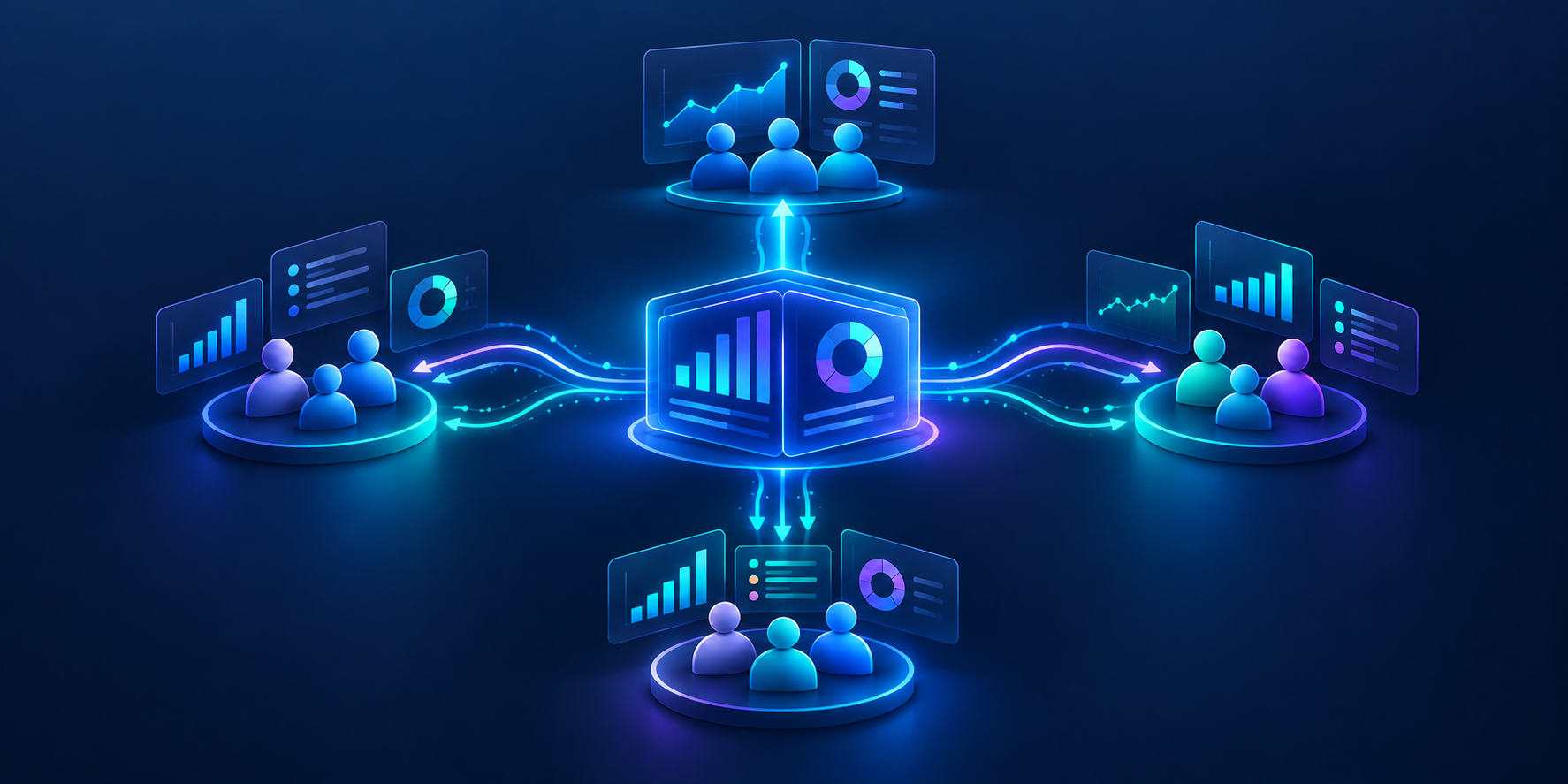
In an era where data drives decisions, the ability to effectively communicate within an organization is more crucial than ever. This communication takes several forms: upward to superiors, downward to teams, and sideways among peers. TargetBoard plans to stands at the forefront of facilitating these diverse communication flows through data.
Upward communication involves conveying information from subordinates to management. In this context, data plays a pivotal role in justifying decisions, presenting results, and suggesting improvements. TargetBoard simplifies this process by providing clear, concise, and compelling data visualizations. This enables employees at all levels to present their findings and insights to upper management effectively, fostering a culture of informed decision-making.
Downward communication is about disseminating information from management to employees. It's essential for creating alignment and directing teams towards common goals. With TargetBoard, leaders can share data-rich, insightful dashboards that clearly articulate goals, progress, and expectations. This approach not only informs teams but also empowers them with the understanding necessary to contribute meaningfully towards organizational objectives.
Sideways or lateral communication is crucial for collaboration among peers. In environments where teams must work together to solve problems and innovate, trust in data and shared understanding are key. TargetBoard fosters this environment by providing a platform where peers can easily share data, insights, and collaborate in real-time. This not only enhances trust but also ensures that problem-solving is grounded in factual, data-driven insights.
Many BI and analytics systems fall short in supporting these types of collaborative communications within a company, often adopting a passive, do-it-yourself, minimalistic approach. TargetBoard is designed to be different. It is not just about presenting data; it’s about creating a space where insights can be shared and acted upon across all levels of your organization. The days of pasting screenshots into management decks are over.
In conclusion, TargetBoard is paving the way for a new era of organizational communication. By enhancing upward, downward, and sideways communication through data, it empowers organizations to operate more cohesively and efficiently. Discover the power of effective communication with TargetBoard. Explore how it can transform your organization's approach to data collaboration.
.png)
Tracking change management requires measuring how an organization adapts its workflows and delivery systems to new initiatives. Whether you are managing Artificial Intelligence integration or complex mergers and acquisitions, the modern executive approach moves beyond static checklists to analyze real-time execution data. You can track change management tracking initiatives effectively by focusing on three core areas:
This approach ensures you measure the actual impact on delivery predictability rather than just ticking off implementation milestones. It shifts the focus from reactive reporting to proactive performance understanding.
Legacy tracking systems still serve a foundational purpose for basic organizational alignment. They provide a structured way to document project scope adjustments and basic employee readiness. But these tools are strictly administrative. They log the plan rather than measure the reality of execution on the ground.
Most organizations start with standard change management tools to organize their initial rollout. These foundational formats usually include:
These change management templates work well for basic workforce shifts. They break down completely when you need to understand complex engineering workflows and system-level friction.
Measuring change management at the administrative level usually involves tracking adoption rates. Leadership teams look at standard lagging indicators to estimate the Return on Investment for a new tool or process. Common metrics include:
These metrics show if employees are using a new system. They don't reveal if that system is actively damaging your delivery predictability or creating coordination bottlenecks.
An implemented change doesn't equal successful execution adaptation. You might deploy a new Artificial Intelligence tool and see adoption rates hit 90 percent. Administrative change management tools will flag this organizational change initiative as a massive success. But on the ground, your engineering delivery speed might be crawling.
Artificial Intelligence accelerates developer output, which naturally increases the volume of code entering your system. According to a 2024 Forrester analysis on AI-assisted development, this rapid code generation often leads to a massive spike in pull request review churn. Standard tracking tools miss this entirely because they only measure the initial output.
A developer uses the tool to write code faster, so the adoption metric looks great. Yet that highly productive individual output chokes your systemic delivery throughput because human reviewers can't process the complex code fast enough. The result is a severe coordination bottleneck that administrative logs cannot detect.
You must measure how the entire system digests a change. Tracking delivery-system adaptation means looking at the friction between teams. If you introduce a new testing protocol, measuring change management can't stop at confirming the team read the memo.
You need to monitor cycle time trends and review churn to see if the new protocol creates duplicated effort. This requires continuous operational intelligence signals rather than lagging output indicators.
Different tools offer vastly different levels of visibility. Here is how foundational tracking methods compare to modern operational intelligence platforms:
As an engineering leader, you know the frustration of watching delivery metrics drop while adoption metrics rise. Traditional change management tracking only logs that a change occurred. It fails to explain why delivery performance drops or how a systemic change introduces hidden workflow friction.
The primary barrier is no longer the visibility of data. The real challenge is gaining an automated understanding of why that data fluctuates. TargetBoard is an agentic operational intelligence platform that helps leadership teams understand how execution is performing, why it is changing, and how to respond.
It connects data across company systems, interprets performance through operational intelligence, and uses domain-expert Artificial Intelligence agents to guide execution decisions. This shift from passive reporting to active intelligence restores your decision-confidence. Using modern change management tools requires this level of cross-system understanding to maintain delivery predictability.
The five pillars of change management for engineering execution are alignment for system adaptation, cross-team execution coordination, proactive measurement, risk mitigation, and continuous performance interpretation. These pillars ensure your organizational change initiatives maintain delivery predictability during major transitions.
Foundational models like ADKAR focus heavily on individual awareness and desire. But in complex engineering environments, you must pivot to system-level adaptation. Alignment means ensuring your planning, code, and delivery systems all reflect the new initiative seamlessly.
A change in one department often creates a bottleneck in another. You need strict execution coordination to ensure a new testing framework does not stall your deployment pipeline. Tracking this requires real-time visibility into cross-team dependencies.
You can't wait for lagging output indicators to tell you a project failed. Proactive measuring change management requires continuous operational intelligence signals. This allows you to catch friction early before it compounds into a systemic delay.
Speed often comes at the expense of long-term code cost. You must track how a new process impacts structural complexity and technical debt. Protecting future maintainability ensures your delivery system remains stable long after the initial rollout.
Data without context is useless to an executive. Continuous interpretation means you always know why cycle time trends are shifting. This context gives you the confidence to adjust resource allocation immediately and keep teams aligned.
Measuring the true impact of change management tracking requires a structured approach. Follow these four steps to measure the real Return on Investment of your next transition.
You can't measure impact if your data lives in isolated silos. Connect your Jira, GitHub, and HR systems to create a unified view of your delivery baseline before the change begins. This single source of truth prevents conflicting reports later.
Monitor how quickly teams adopt the new process or software. This provides the initial signal that the rollout is active. Just keep in mind that high adoption rates don't guarantee delivery success.
Compare your current cycle times and review churn against your historical baseline. According to a 2023 Gartner report on digital transformations, over 70 percent of complex change initiatives fail to meet their original speed targets. You must watch these benchmarks closely to avoid becoming part of that statistic.
Assess whether the change created new technical debt or coordination gaps. A successful transition improves systemic throughput without sacrificing the long-term health of your codebase. Connect your code decisions to future maintenance risks to ensure lasting Return on Investment.
Evaluating a transition requires looking past the surface. While the SPACE framework and DORA metrics provide useful high-level signals, they can't explain why those signals change. Here is how traditional measuring change management metrics compare against a systemic operational approach using modern change management tools:
Operational intelligence is a supportive layer that guides your strategy, so it doesn't replace executive human judgment. When you integrate agentic tracking into your change management tracking efforts, you empower your leaders to make objective decisions based on reality.
You stop reacting to stale organizational change initiatives and start proactively managing your delivery pipeline. Understanding these patterns gives you a clear framework to maintain delivery predictability, reduce manual reporting overhead, and build lasting trust with your board.
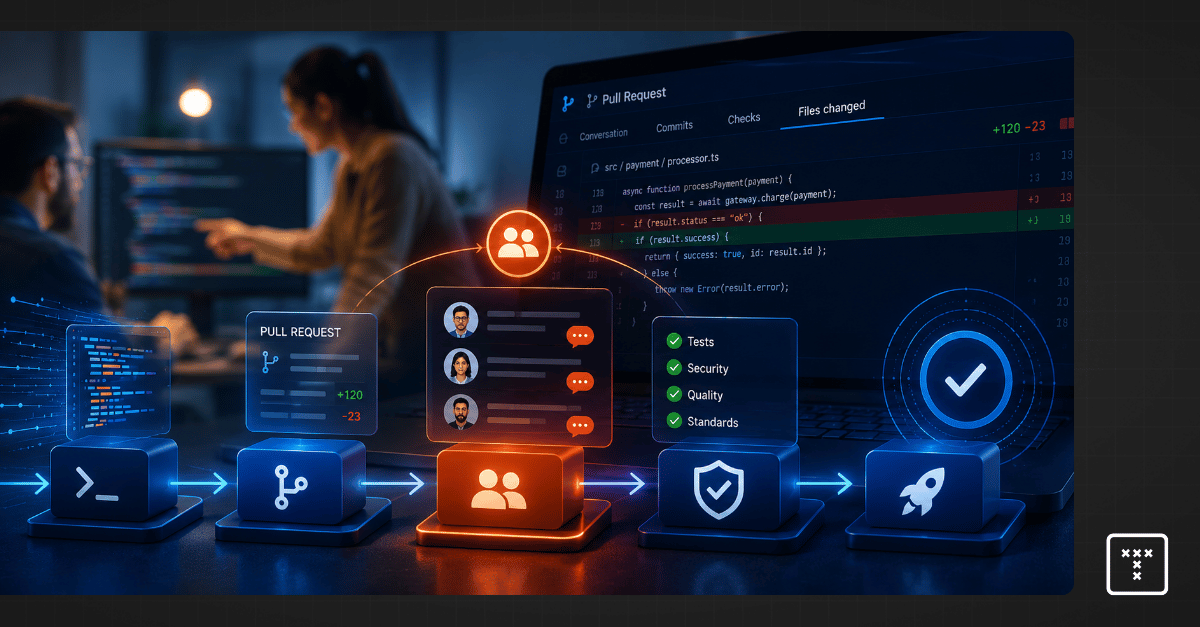
A good code review process functions like a smooth traffic system rather than a rigid tollbooth. When engineering executives ask how to do a code review at scale, they often mistakenly push developers to review code faster. That approach fails because it ignores the underlying workflow physics.
A mature code review process limits work-in-progress, automates syntax checks, and explicitly unblocks cross-team dependencies. This operational shift guarantees delivery predictability by keeping work moving efficiently through the pipeline.
To scale a peer code review system, you must stop managing individuals and start managing the system constraints. Peer review breaks down completely when treated as a behavioral checklist.
We have all seen the immediate output boost from AI coding assistants. But this massive surge in AI-generated code fundamentally breaks traditional human-dependent review bottlenecks. Human review capacity remains entirely static, so the exponential increase in code volume clogs the pipeline. This AI impact forces engineering leaders to rethink how inspection works at scale.
Engineering teams are shipping more pull requests than ever before. This looks like a massive productivity win on a static dashboard. But the reality introduces severe operational risk.
AI models can generate structurally plausible code that harbors deep hidden complexity. Reviewers facing a massive backlog often skim these large changelists because they lack the time to inspect every line. This allows technical debt to enter the system silently, which degrades long-term code maintainability and slows down future development.
When code volume surges and complexity rises, review dependencies naturally centralize. Teams unconsciously route the most difficult pull requests to a few highly trusted engineers. These "hero" engineers quickly become single points of failure.
They hold up dozens of tasks while trying to protect the system architecture from instability. Traditional metrics will show cycle times slowing down across the board, but they completely fail to explain that this centralization is the root cause. You need objective operational data to unblock these dependencies without resorting to micromanagement.
Transforming your pipeline requires objective rules that govern how work moves through the system. Implementing the best practices for peer code review means setting boundaries that protect engineering throughput and guarantee delivery predictability.
To review code effectively at scale, follow these seven operational steps:
A comprehensive SmartBear study shows that defect discovery rates drop significantly when pull requests exceed 200 to 400 lines of code. You must enforce strict PR size limits to keep batches small and readable. Combining this with rigid work-in-progress limits prevents massive code dumps from clogging the review queue and stalling the entire team.
Reviewers waste hours trying to reverse-engineer the intent behind a code change. Mandate strict commit message formatting and standard code review checklists so reviewers never have to guess the intent behind a code change. Providing this automated context ensures the reviewer understands the strategic goal before they read a single line of code.
Establish inspection rate limits of 60 to 90 minutes per session as a general guideline because human cognitive focus degrades rapidly during highly detailed tasks. Treating this timeframe as a strict boundary maintains a high defect discovery rate and protects your team from review notification fatigue.
Human reviewers should never argue about spacing or variable naming. Continuous Integration pipelines and automated linters must handle all formatting rules. Automating these checks eliminates subjective review decisions and reserves human attention for architectural edge cases where automated tools fail.
Vague expectations destroy software delivery performance. Define exact code quality baselines at the system level so reviewers can evaluate changes against objective operational signals rather than inconsistent developer etiquette.
Infinite asynchronous feedback loops kill momentum. When a pull request hits three rounds of comments, you must trigger a mandatory synchronous communication escape. Shifting from async PR churn to a quick five-minute video call resolves misunderstandings instantly and gets the code merged.
Requiring a single principal engineer to approve every change creates massive delays. Update your codeowners configurations to distribute review responsibilities across multiple qualified peers, which instantly unblocks cross-team dependencies and keeps teams focused on shipping.
You can't fix a slow pipeline by asking developers to work harder. Pushing teams to review faster is a common executive mistake that completely ignores the root cause of the delay. You make the process easier by reducing the cognitive load required to approve a change and fixing the system workflow. High review churn usually indicates a breakdown in requirements rather than a lack of coding skill.
Leaders must deploy operational intelligence to identify exactly where these breakdowns occur. When you track the specific stage where a ticket stalls, you can adjust the workflow to restore a predictable sprint velocity.
The 80/20 rule in coding dictates that 80 percent of your value comes from 20 percent of your effort. Apply this exact principle to your review pipelines so reviewers spend 80 percent of their time analyzing the 20 percent of the codebase that carries the highest risk.
You have to accept deliberate delivery tradeoffs. Not every internal script requires the same rigorous inspection as your core payment gateway. Focusing human effort on high-risk areas protects long-term code maintainability and ensures that necessary refactoring does not derail your primary delivery goals.
Standard DORA metrics provide lagging indicators of software delivery performance. They tell you that cycle time is slowing down, but they completely fail to explain why the delay is happening. When you rely solely on these static dashboards, you lack the objective operational signals needed to make confident decisions.
To actually unblock your pipeline, you need to see the hidden dependencies. TargetBoard is an agentic operational intelligence platform that helps leadership teams understand how execution is performing, why it is changing, and how to respond. It connects data across company systems, interprets performance through operational intelligence, and uses domain-expert AI agents to guide execution decisions.
While a traditional dashboard shows a delayed sprint, TargetBoard's AI agents quantify Artificial Intelligence-generated versus human code. They uncover hidden single points of failure and highlight workflow breakdowns in real-time. This translates raw data into actionable insights so leaders can make data-driven decisions to unblock their pipelines.
Understanding the difference between passive tracking and active intelligence is the key to scaling your engineering organization.
Mastering code review best practices means shifting your perspective from individual behavior to system design. You now have a clear framework to enforce work-in-progress limits, automate context, and decentralize review dependencies.
Applying these principles protects your engineering throughput from the massive volume of AI-generated code. Start by auditing your current inspection rate limits and identifying any hidden "hero" engineers in your pipeline, since removing those single points of failure immediately stabilizes delivery predictability and gives your team the autonomy they need to ship with confidence.
.webp)