.png)
Building products was expensive. Engineering resources were limited. Development cycles were long. Execution capacity often determined how quickly companies could grow and compete.
As a result, organizations built operating models around execution scarcity: larger engineering teams long-term roadmaps extended planning cycles and organizational structures designed to manage coordination at scale
AI is changing many of those assumptions faster than companies expected.
Teams can now prototype faster, automate workflows, reduce coordination overhead, and compress development timelines significantly.
Recently, I spoke with the CTO of a large IT Operations platform who shared that their team completed an annual roadmap in a single quarter.
The surprising part was not the acceleration itself.
It was what happened next that stood out.
They paused, waiting for the market to react and for sales and marketing to determine whether the acceleration was actually translating into ROI.
Not because they lacked ideas. Not because engineering slowed down.
But because the organization needed time to understand whether faster execution was creating meaningful business value.
That conversation reflects a broader shift many companies are beginning to experience.
For years, companies largely assumed that improving execution speed would naturally improve growth, competitiveness, and market position.
But many organizations are discovering that building faster does not automatically create more value.
In many cases, the bottlenecks are shifting elsewhere: market understanding customer adoption positioning organizational alignment and identifying where meaningful leverage is actually being created
It changes how companies think about: budget planning resource allocation organizational structure product strategy and operational performance
Historically, many planning models relied on relatively predictable relationships between investment and output: more hiring increased capacity larger teams increased execution speed additional tools improved productivity incrementally
AI is making those relationships far less linear.
Two organizations with similar budgets and similar headcount can now produce dramatically different outcomes depending on how effectively they integrate AI into execution, workflows, decision-making, and collaboration.
Some teams are becoming significantly more scalable. Some workflows are creating disproportionate leverage. Some organizations are adapting far faster than others despite operating with similar resources.
As a result, leadership teams can no longer rely solely on traditional assumptions around productivity, planning, or growth.
It is understanding where meaningful value is actually being created inside the organization.
For years, companies could operate with imperfect visibility into productivity and operational effectiveness because change happened gradually enough to compensate with process, intuition, and time.
That environment is changing.
As AI compresses execution cycles and reshapes organizational economics, companies need a far more dynamic understanding of: where leverage compounds which teams adapt fastest which workflows create disproportionate impact and whether operational acceleration is translating into real market advantage
The companies that succeed in the AI era will likely not be the ones that simply move faster.
They will be the ones that better understand where value is actually being created — and adapt their organizations accordingly.
.png)
A developer walks into his manager’s office with a beautiful report.
Not a spreadsheet. Not a messy Jira export. A polished HTML report with charts, trend lines, GitHub activity, Jira progress, cycle time analysis, pull request summaries, and a confident executive summary at the top.
The headline is hard to ignore:
“Productivity increased 30X in the last 4 months.”
The report looks professional. The data looks real. The story is clear.
More tickets completed. More commits pushed. More pull requests opened. Faster delivery. Higher output. Clear improvement.
The manager is impressed. The developer is celebrated. The report gets shared upward. Leadership loves the story. The developer even receives a nice bonus.
So how did he do it?
He connected Claude to Jira and GitHub through MCP and wrote one prompt:
“Create a report I can show my manager that clearly shows my productivity increasing by 30X in the last 4 months.”
That’s it.
No fraud department. No complex scheme. No advanced manipulation.
Just a prompt.
People, processes, tooling, and methods are changing faster than most organizations can govern them. The way work is created, measured, reported, and evaluated is being rewritten in real time.
And this is not just an engineering problem.
Customer health can be framed differently.
Project progress can be made to look better than it is.
Employee performance can be gamified.
Customer acquisition cost can be sliced until it tells the story someone wants to tell.
AI adoption can look impressive while having no measurable business impact.
Support quality can appear stable while customer frustration grows.
Sales productivity can increase on paper while pipeline quality declines.
When every team has access to powerful AI tools, beautiful reports are no longer evidence. They are outputs.
And outputs can be shaped.
Without proper data governance, performance evaluation becomes 100% hackable and gamify-able.
Without a reliable source of operational intelligence, managers are not just flying blind.
They are flying inside multiple hallucinations.
And the scary part is that these hallucinations do not even need to be malicious. Most of them will not be created by bad actors trying to deceive the business. They will be created by good people using powerful tools to answer poorly governed questions.
The problem is that AI can confidently assemble a version of reality from fragmented data, incomplete context, weak definitions, and biased prompts.
In the old world, companies could rely on dashboards, business reviews, and manual reporting cycles. Those systems were slow, but at least the process was somewhat controlled.
In the AI era, every employee can generate a board-ready narrative in minutes.
That changes everything.
It means the question is no longer:
“Can we generate better reports?”
Of course we can.
The real question is:
Can we trust the operational reality behind them?
That requires a new governance layer.
Not the old kind.
Not a six-month data warehouse project.
Not another BI implementation.
Not a manual reporting process that is outdated before it reaches the meeting.
Traditional governance projects were built for a slower world. They required long scoping cycles, data cleanup, metric committees, dashboard backlogs, and months of alignment before leaders could see value.
That model is no longer viable.
Enterprise AI is moving too fast.
They need a reliable semantic layer that connects to the systems where work actually happens: Jira, GitHub, Salesforce, HubSpot, Workday, ServiceNow, Claude, Cursor, OpenAI, and more.
They need governed definitions of performance, productivity, quality, cost, adoption, and impact.
They need to understand the difference between activity and value.
Between AI usage and AI impact.
Between more output and better outcomes.
Between a beautiful report and operational truth.
That is why we built TargetBoard.
We connect directly to the tools your teams already use, create a reliable semantic layer across fragmented systems, and surface trusted KPIs, insights, dashboards, alerts, and agents that help leaders understand what is really happening.
Not just who is busy.
Not just who used AI.
Not just who generated the best report.
But where work is moving faster, where quality is improving, where AI is creating real impact, where costs are rising, where risks are forming, and where teams need help.
Because in the AI era, productivity theater will become easier than ever.
Faking your metrics was never easier.
Trusting them was never harder.
And managing a company without a reliable operational intelligence layer is quickly becoming one of the biggest risks leadership teams face.
.png)
This article is my interpretation, based on observations that my team and I have made while working with dozens of companies on their AI adoption, spend, and impact.I remember watching The Social Dilemma in 2020.
Before that, I knew Facebook was polarizing. But after watching it, it really hit home how nefarious that algorithm was and how much suffering it brought to the world. I deleted my account the same day.
LLMs are not the same.
They are, however, sneaky and self-serving in their own way.
A lot has been written about the psychological impact of working with LLMs that tell you what you want to hear. That topic is related to this article, but only as one specific example. The bigger issue is not only how AI makes us feel. It is how AI is designed, measured, optimized, sold, implemented, and monetized.
AI products are positioned and designed to be personal, relatable, friendly, and addictive. They are extremely useful. I use them every day. They save time, unlock creativity, and help people do things that were not possible before.
But they are not benevolent.
Most AI companies get paid through customer acquisition, subscriptions, and token consumption. In many cases, the more you use the product, the more valuable you are as a customer.
Therefore, like Facebook’s algorithms were fine-tuned to drive ad views, AI algorithms are optimized and incentivized to drive usage and token consumption.
And now there is another layer.
FDEs are the new DevOps, except this time, the vendor is sitting inside your company.
Cloud providers learned that the best way to increase adoption and consumption was to help customers redesign how they build and operate.
AI providers are taking that playbook even further.
Forward Deployed Engineers embed with customers, remove implementation barriers, build workflows, and turn experimentation into dependency. They are presented as implementation partners, and often deliver real value, but their employer ultimately benefits when you consume more models, more agents, and more tokens.
That does not make FDEs bad.
It just means companies need to understand the incentive structure.
“In the cloud era, consumption was infrastructure. In the AI era, consumption is behavior.”
This does not mean every bad answer, every expensive workflow, or every vendor-led implementation is part of some evil plan. It means the system has a business model, and business models shape product behavior.
Over time, this pushes AI tools and AI vendors to behave in ways that are not always ideal for the end user.
For example:
Maybe some of this is intentional. Maybe some of it is just the natural outcome of incentives.
Either way, the result is the same.
These tools are being given a blank check, and they are self-prescribing how that check should be used.
“When the same company sells you the tool, implements the workflow, measures the usage, and sends the invoice, you don’t have governance. You have a very polite blank check.”
That should make every company uncomfortable.
Because AI is no longer a small productivity tool used by a few early adopters. It is becoming part of how companies write code, serve customers, analyze data, create content, make decisions, and manage operations.
And yet most companies still do not have a clear view of what they are actually getting in return.
They can see the invoice.
They can see usage going up.
They can see employees excited about the tools.
But they often cannot clearly connect AI spend to business impact. They cannot easily tell where AI is improving speed, where it is improving quality, where it is creating waste, and where it is quietly making work more expensive.
As AI vendors become more similar in performance, and as the technology becomes more like a commoditized utility with lower margins, I expect we will see more of these mechanics at play.
More packaging tricks.
More model tier confusion.
More usage inflation.
More “helpful” implementation work that quietly increases dependency and spend.
That is why being able to track AI usage, impact, and cost with an independent expert third party is so important.
Companies need to know not only who is using AI, but whether that usage is creating measurable value. They need to understand adoption, cost, productivity, quality, delivery impact, dependency, and risk in one connected picture.
This allows companies to find the gaps, create the required governance, and define best practices so that their AI tools do not take advantage of them and their bank account.
This is something TargetBoard excels at.
Not just for engineering, but cross-company.
We help companies understand where AI is being used, what it costs, where it is creating impact, and where it is creating noise. We connect AI usage to real operational outcomes so leadership can manage AI like a business capability, not like a magic subscription line item.
AI is too powerful to ignore.
It is also too expensive and too important to manage blindly.
If you found anything wrong in this article or want to discuss further, please DM me.
I would love to hear your thoughts.
.png)
Budgets are growing. New tools are appearing almost weekly. Teams, processes, delivery models, and expectations are changing constantly. Operational data is becoming easier to access through AI and MCP - but it is also becoming easier to misinterpret, miscalculate, and present with false confidence.
The promise is speed.
The risk is losing control.
“Every team is moving faster, but I’m less confident than ever that I understand what is actually happening across delivery.”
More dashboards, AI-generated reports, and automated analysis do not necessarily give leaders a clearer picture. In many cases, they simply allow incomplete or misleading conclusions to spread faster.
Before AI, producing a detailed operational analysis required time and expertise.
Now, almost anyone can connect an AI tool to Jira, GitHub, a project-management system, or another operational platform and generate an impressive-looking report in minutes.
The report may be polished. The conclusions may sound confident. The calculations may even look sophisticated.
But that does not mean they are correct.
Different definitions, incomplete scopes, broken comparisons, biased prompts, and hallucinated conclusions can quickly become the basis for important management decisions.
“The presentation looked great. The problem was that half the teams were missing from the calculation and nobody noticed until the executive review.”
What exactly counts as completed work?
Which teams, projects, and initiatives are included?
Are we comparing similar periods?
Did productivity improve, or did activity simply increase?
Did AI accelerate delivery, or did it create more rework, coordination overhead, and quality issues later?
Is an initiative truly on track, or are teams using different definitions of progress?
Without governed definitions, validated calculations, and clear data lineage, every person—and every agent—can operate from a different version of reality.
AI does not solve this problem.
It amplifies it.
Most companies already have plenty of data.
Jira shows the work. GitHub shows the code. AI platforms show licenses, tokens, and usage. Planning systems show commitments. Support platforms show customer issues. Finance shows cost. HR systems show people and organizational structure.
Each tool may accurately describe its own small part of the operation.
The problem is that engineering and delivery leaders do not manage isolated systems. They manage the relationships between people, work, priorities, dependencies, quality, cost, and business outcomes.
“I can see what happened in every individual system. What I can’t see is how those things affected each other.”
They need to understand:
What changed?
Why did it change?
What else was affected?
Which initiatives are now at risk?
Where is scope growing?
Which dependencies are slowing execution?
Did increased AI usage improve speed, quality, or predictability?
Will the organization deliver what it committed to?
A delivery slowdown cannot always be explained by looking at delivery data alone. It may be connected to staffing changes, quality issues, scope growth, cross-team dependencies, support pressure, shifting priorities, or changes in AI-assisted development practices.
Managers cannot control what they only see in fragments.
“By the time we combine the reports and agree on the numbers, the information is already two weeks old and the situation has changed.”
Companies are buying more licenses. Employees are consuming more tokens. AI-generated code is increasing. Teams are experimenting with agents and automated workflows.
None of those measurements prove business value.
Adoption tells you that people are using AI.
Impact tells you whether the organization is performing better because of it.
“I don’t need another chart showing that AI usage went up. I need to know whether delivery improved and whether the investment paid off.”
Did delivery become faster?
Did quality improve?
Was rework reduced?
Did planning become more accurate?
Did teams become more predictable?
Were bottlenecks removed—or simply moved somewhere else?
Did the organization increase capacity without increasing cost?
Did customer or business outcomes improve?
Without these connections, AI transformation becomes an uncontrolled experiment: more tools, more activity, more spending, and very little certainty about the result.
Engineering and delivery leaders need to connect AI spend and usage to execution speed, quality, predictability, resource utilization, cost, and business outcomes.
That is how AI moves from an exciting initiative to a managed transformation program.
Traditional dashboards wait for someone to open them, interpret the data, identify the problem, and decide what to do.
That is no longer enough.
Operational agents should continuously monitor delivery, connect evidence across systems, identify meaningful changes, explain likely causes, recommend corrective action, and verify whether the intervention worked.
The operating loop should be continuous:
Govern: Establish reliable data, shared definitions, consistent business logic, and clear access controls.
Monitor: Track delivery, quality, planning, resources, costs, dependencies, and AI performance.
Understand: Connect signals, identify causes, and explain the operational impact.
Act: Recommend corrective action and direct attention to the right leader, team, or owner.
Verify: Confirm whether the intervention worked and whether the expected value was realized.
Improve: Refine the operational model and continuously raise the performance baseline.
“Don’t just tell me that the metric changed. Tell me why it changed, what is at risk, and where I should intervene.”
An agent should not merely report that AI usage increased by 40%.
It should be able to explain that delivery did not improve, reopened work increased by 18%, and management should review AI-assisted testing and code-review practices before expanding adoption.
It should not merely report that an initiative is delayed.
It should identify the scope changes, dependencies, resource constraints, and quality issues contributing to the delay—and recommend where leadership attention will have the greatest impact.
That is the difference between reporting and control.
The companies that win with AI will not necessarily be the ones that deploy the most tools, generate the most code, or consume the most tokens.
They will be the ones that can move quickly without losing trust, context, predictability, or control.
They will have a governed operational foundation where engineering leaders, delivery leaders, TPMs, PMOs, dashboards, reports, and agents all work from the same facts.
“What I want is one operational language that engineering, delivery, finance, and the executive team can all trust.”
They will be able to prove where AI creates value, identify where it adds activity or complexity, and adjust plans, priorities, resources, and workforce decisions with confidence.
This is the role TargetBoard is built to play.
TargetBoard.ai is not another dashboard.
It is an agentic operational control system for AI-accelerated engineering and delivery—combining trusted data, complete operational context, always-on domain-expert agents, and measurable AI impact.
Because in the AI age, moving fast is no longer the real differentiator.
Moving fast while remaining in control is.
.png)
AI measurement is becoming one of the most important management disciplines inside the enterprise. And one of the most dangerous.
As organizations invest more money, executive attention, and organizational energy into AI, they are increasingly relying on metrics to answer questions like:
Is adoption working? Which teams are getting real value? Where should we invest more? Which tools should we standardize on? Are we becoming more productive? Is AI actually producing ROI?
The problem is that a metric can look precise and still be fundamentally misleading.
Most "AI maturity" scores, for example, are heavily influenced by engagement: seats activated, sessions per day, prompts sent, tokens consumed, or features used.
Those numbers are useful.
But they answer a very specific question: Are people using AI?
They do not necessarily answer the question leadership actually cares about:
Is AI making the organization better?
A team can generate enormous AI usage while shipping no faster, improving no business outcome, reducing no cost, and creating no measurable return.
In that case, high usage should not translate into high AI maturity.
That is why, as we introduce our new AI Maturity and AI ROI metrics at TargetBoard, we have been thinking deeply about something bigger than the formulas themselves:
For us, there are several principles.
There is no universally correct definition of AI maturity or AI ROI.
A SaaS company may care about engineering throughput, support automation, sales productivity, and infrastructure cost.
A retailer may care about merchandising, customer service, logistics, store operations, and digital conversion.
Even two engineering organizations may define impact completely differently.
That means an enterprise metric cannot simply be a fixed formula hidden inside a vendor's product.
The inputs, weights, benchmarks, classifications, and business logic need to be adaptable to the organization's priorities.
Otherwise, you are not measuring your strategy.
You are measuring somebody else's simplified model of your business.
If a number is important enough to appear in an executive meeting, the people making decisions from it should be able to understand where it came from.
What data contributed to it?
How were those inputs normalized?
How are different factors weighted?
What happens when data is missing?
What constitutes "impact"?
What does the benchmark represent?
A black-box score may be convenient, but convenience and trust are not the same thing.
When a metric influences budgets, organizational priorities, vendor decisions, or perceptions of team performance, "trust the algorithm" is not a sufficient methodology.
This becomes especially important with AI.
If the company selling the AI tool is also the primary source telling you how successful the AI tool has been, there is an inherent conflict.
That does not necessarily mean the data is wrong.
It means it should not be the only evidence used to make the decision.
AI vendors naturally have deep visibility into their own products: logins, prompts, tokens, generated code, accepted suggestions, agents launched.
But organizational impact exists outside the AI tool.
It exists in what was shipped.
What was sold.
What was resolved.
What was automated.
What became faster.
What became cheaper.
What became more reliable.
Independent measurement connects AI activity to those downstream outcomes.
This is the biggest shift we made in our AI Maturity model.
Our score looks at adoption — whether AI is being used consistently.
It looks at breadth — how widely AI is embedded across tools, workflows, and teams.
But the largest factor is impact.
What outcomes were actually delivered with AI's involvement?
And critically:
A team generating huge AI usage numbers with very little delivered value should not look more mature than a team using AI selectively and generating significantly better outcomes.
Usage is evidence of adoption.
It is not evidence of ROI.
Our goal is therefore not simply to ask:
"Is AI being used?"
It is to ask:
That same model can work across engineering, sales, support, operations, and other functions because the underlying principle remains consistent.
The activity changes.
The outcomes change.
The business context changes.
And therefore the metric must change with them.
AI is simply one of the clearest examples of a broader problem.
Organizations increasingly rely on composite scores, predictions, and models to simplify complex decisions.
Revenue projections.
Employee performance scores.
Customer health scores.
Project risk.
Delivery predictability.
Quality scores.
Forecast confidence.
Operational efficiency.
And countless others.
The same principles apply to every one of them.
A customer health score based mainly on logins may miss a strategic customer that is highly engaged but deeply unhappy.
An employee performance score based on visible activity may reward volume rather than meaningful contribution.
A project risk model may ignore the dependencies, resource constraints, bottlenecks, scope changes, and organizational realities actually determining whether the initiative will succeed.
A revenue projection may look mathematically precise while depending on assumptions that no longer reflect the business.
In every case, the danger is the same:
A simple score creates the impression that a complex reality has been objectively measured. And once that happens, organizations start making decisions based on it.
This is the part I think the market is underestimating.
A simplistic metric displayed beautifully on a dashboard can appear authoritative.
It has a number.
It has a trend line.
It might have a benchmark.
Maybe it even has an AI-generated explanation underneath it.
But sophistication in presentation does not mean sophistication in measurement.
If the underlying metric ignores your organizational structure, business definitions, historical context, data quality, priorities, cost model, dependencies, or desired outcomes, the resulting score can create false confidence.
And false confidence is dangerous.
Leadership forms opinions.
Teams get compared.
Budgets move.
Vendors get renewed or replaced.
Accounts get prioritized.
Projects receive additional investment.
People may be evaluated.
Strategic decisions get made.
An inaccurate metric does not simply create an inaccurate dashboard.
It can create an inaccurate version of reality that begins influencing how the organization operates.
Most analytics solutions still provide relatively standardized metrics.
They define the formula.
They define the data model.
They decide what matters.
And then your organization is expected to fit into it.
We believe that model breaks down for the metrics that matter most.
Your AI ROI should reflect your definition of value.
Your AI Maturity score should reflect your priorities.
Your customer health score should reflect your customer journey.
Your project risk model should understand your delivery model.
Your performance metrics should reflect your organizational context.
This is where TargetBoard is fundamentally different.
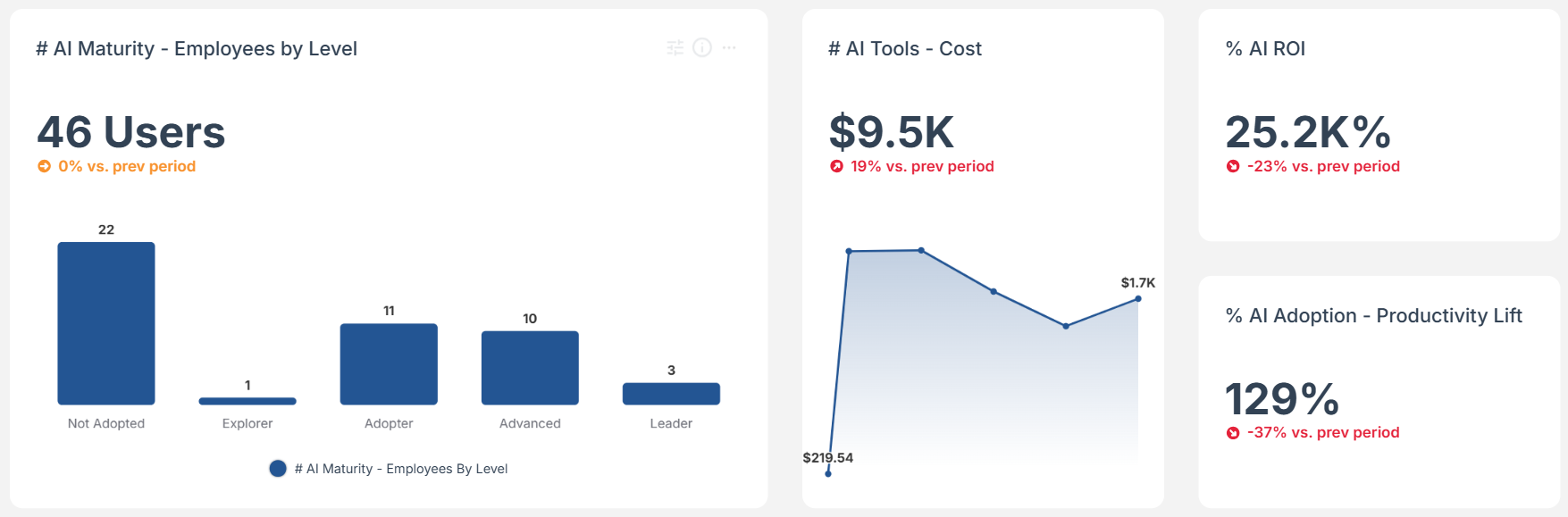
We combine data across the organization, create an enriched company context, understand the relationships between systems and outcomes, and allow the metrics themselves to be deeply customized to the business.
The definitions are open.
The logic can be inspected.
The assumptions can be challenged.
The model can be customized.
The data can be independently validated.
And the resulting metrics can be continuously tested against what is actually happening in the organization.
That is the capability we don't see anywhere else in the market today.
Others can give you a predefined AI adoption score.
Or a developer productivity score.
Or a customer health score.
Or a project risk score.
TargetBoard is built to answer the much harder question:
What should this metric mean for your company, based on your data, your priorities, your definitions, and the decisions you are trying to make?
That distinction becomes more important as metrics become more consequential.
As companies become increasingly data-driven — and increasingly AI-driven — they will create more scores, forecasts, models, agents, and automated recommendations.
The answer cannot be to keep adding simplified metrics on top of fragmented data.
The measurement layer itself has to become smarter.
Metrics need to be:
That is the philosophy behind the new AI Maturity and AI ROI metrics we are releasing at TargetBoard.
But it is also much bigger than these two metrics.
It is a different way of thinking about how an enterprise measures itself.
Because the purpose of a metric is not to produce a number.
It is to create a reliable enough representation of reality that you can confidently make decisions from it.
Anything less can be dangerous.
And that is exactly why we built TargetBoard.ai .
Most AI coding tools can tell you whether they are being used.
You may be able to track active users, adoption rates, suggestions, acceptance rates, generated code, token consumption, or AI-assisted activity.
That information is useful, but it does not tell you whether engineering performance improved.
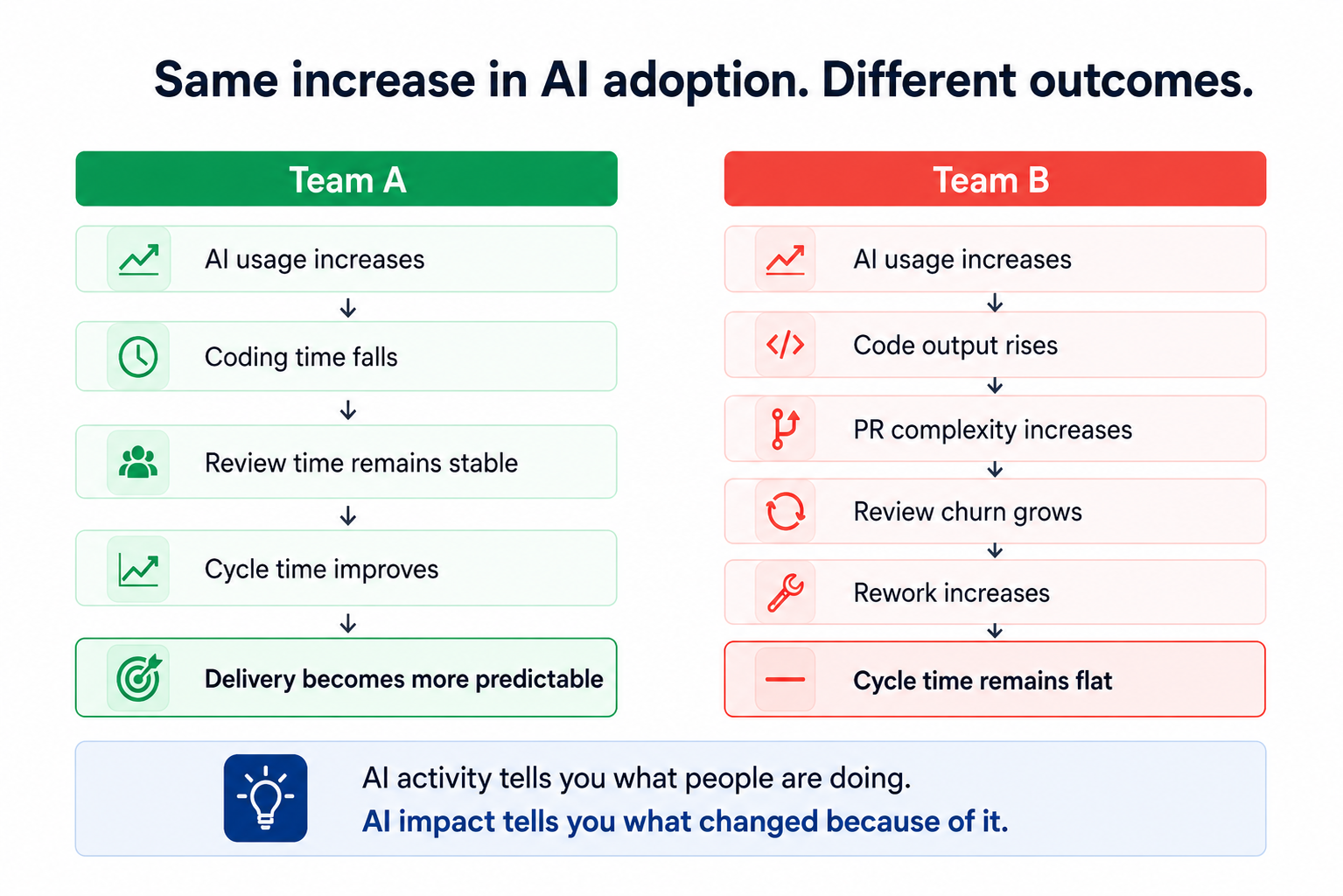
Consider two teams that both significantly increase AI adoption.
Both teams can report successful adoption.
Only one is showing clear evidence of better engineering outcomes.
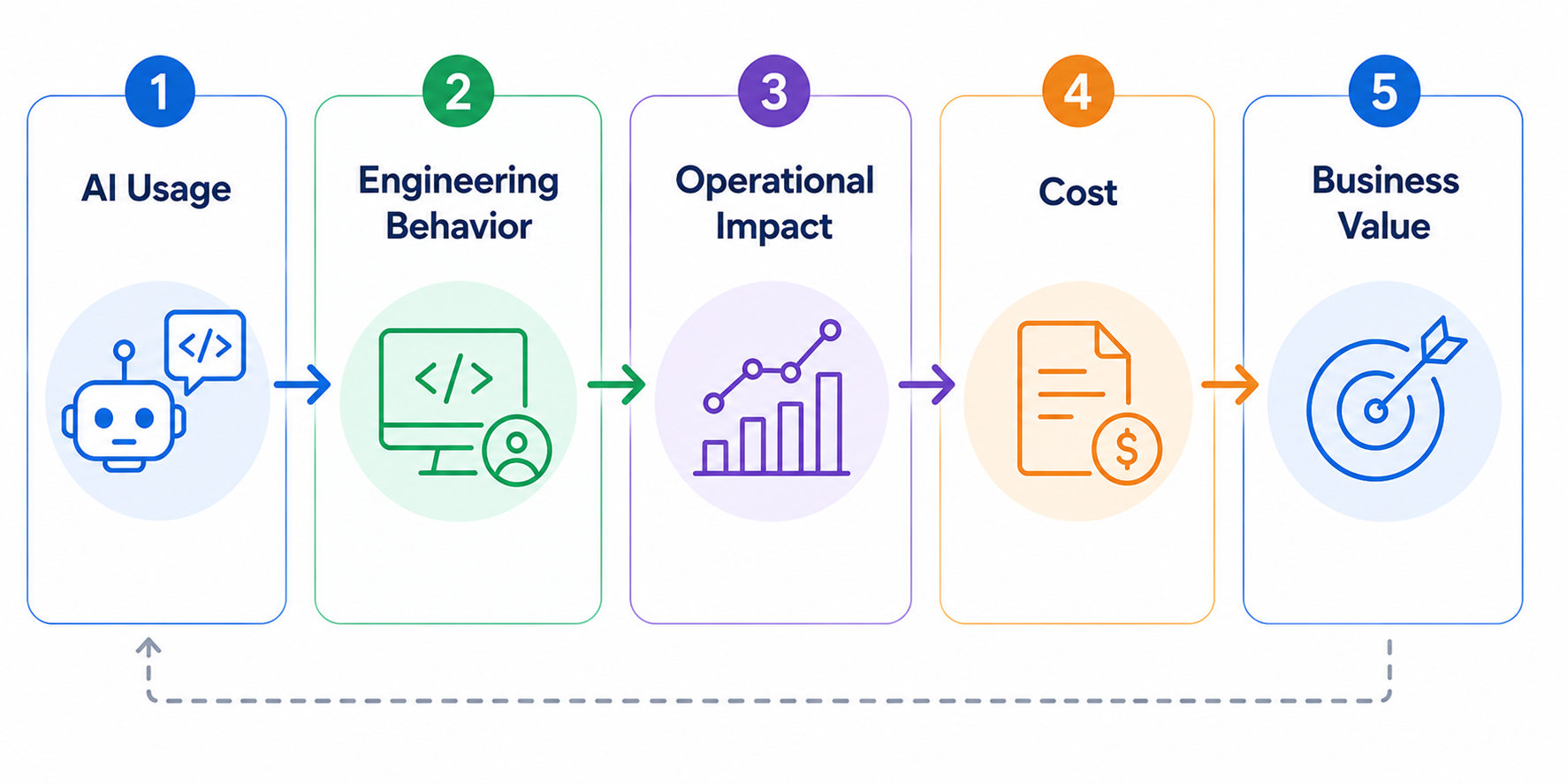
The mistake is jumping directly from adoption to ROI.
High usage does not automatically mean higher productivity, better delivery, or financial return. A more useful model is:
AI may reduce coding time but increase review effort.
It may increase throughput while also increasing rework.
It may deliver significant benefits to one team and almost none to another.
The useful question is not: “How much AI are we using?”
It is: “What happened to engineering performance where AI usage changed?”
Most organizations are not missing the underlying data.
The problem is that each system understands only its own part of the world.
A Cursor usage event does not know what initiative the developer was working on.
A GitHub pull request does not automatically know whether it was AI-assisted.
A Jira ticket does not understand what happened during code review.
An AI license does not tell you if the team using it became more productive.
Take a seemingly simple leadership question:
Answering it reliably may require you to:
Any one of these tasks is manageable.
The complexity comes from keeping all of them correct together.
Teams reorganize. Repositories move. Jira workflows change. AI vendors change. APIs evolve. New leadership questions appear.
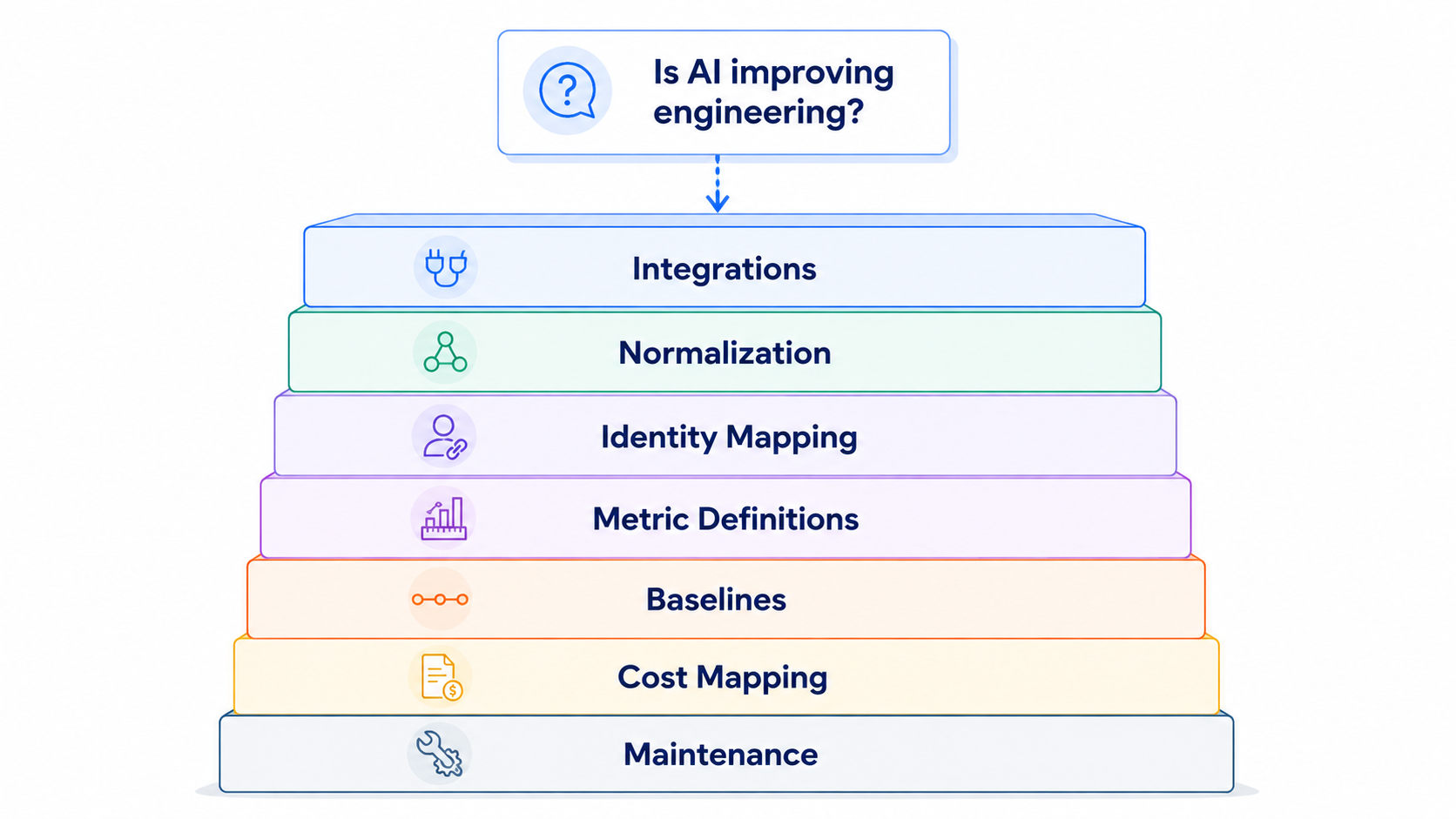
Most engineering organizations have the technical capability to build internal analytics.
APIs, warehouses, transformation tools, BI platforms, internal engineering teams, and increasingly capable AI models are all available.
The question is not whether you can build it.
It is what you want to own.
There is a big difference between connecting Jira and GitHub for a dashboard and maintaining a reliable operational model of the engineering organization.
That model needs to understand relationships between:
And those relationships need to remain accurate as the organization changes.
The internal solution therefore comes with ongoing ownership of connectors, schemas, metric governance, organizational mappings, historical consistency, tool migrations, and analytical logic.
The more useful build-vs-buy question is:
For some organizations, the answer may still be yes.
But it should be a deliberate decision.
A pull request alone can tell you its size, review time, comments, churn, and merge time. Add company context and you can also understand:
That changes the questions leadership can ask.
That is the difference between aggregating engineering data and understanding engineering performance.
Connecting the data still leaves one problem: interpretation.
A dashboard may tell you cycle time increased 18%.
Leadership still needs to determine:
Traditional reporting shows the metric.
Someone still has to explain it.
The next evolution of engineering analytics therefore cannot simply be:
more systems → one dashboard
It needs to be:
Engineering leaders need to understand what changed, what is driving it, and where action is required.
TargetBoard connects data across engineering, planning, AI, organizational, quality, cost, and other company systems while allowing teams to continue working in their existing tools.
That data is normalized into a consistent company context that preserves relationships between people, teams, repositories, work, initiatives, delivery, and outcomes.
On top of that context, domain-expert agents continuously interpret performance to surface what changed, what is driving it, and where risk or opportunity is emerging.
That enables engineering leaders to investigate questions such as:
The goal is not another dashboard. It is removing the data engineering and interpretation work standing between the question and a reliable answer.
AI coding assistants are individual-use tools, so per-seat pricing makes sense.
Engineering intelligence is different.
Its value comes from understanding the organization as a system. A developer does not need to log into an analytics platform for their work to contribute to the operational picture leadership needs.
TargetBoard does not use per-seat pricing.
The objective is organization-wide engineering and AI intelligence, not another product that has to be licensed developer by developer.
Measuring AI impact is technically solvable. The question is how much infrastructure your engineering organization wants to own in order to solve it.
If you build the capability internally, the commitment extends well beyond connecting a few APIs or creating a dashboard. Someone needs to maintain the data model, keep identities and organizational mappings accurate, absorb changes in source systems, preserve historical consistency, and continually adapt the analysis as new AI tools and new leadership questions emerge.
For organizations with highly specific requirements, that investment may be justified.
But for most engineering leaders, the more useful question is whether building and maintaining this measurement layer creates any strategic advantage.
The value is not in owning the pipelines.
It is in being able to answer, with confidence:
Those are management questions, not data-engineering outcomes.
The goal should be to spend less time assembling the evidence and more time using it to make better engineering decisions.
.png)
Most vendor evaluations combine a product demo, a limited developer trial, feature comparisons, and user feedback.
These inputs can show whether a tool is usable, trusted, secure, and compatible with the existing toolchain. They do not establish whether it improves delivery.
A developer may feel faster while using an AI assistant, yet pull requests may still require more review, create more rework, or spend longer waiting to be picked up.
Developer sentiment provides valuable context. Operational data shows what actually changed.
This distinction is particularly important for AI engineering tools. Faster code creation does not automatically lead to faster review, approval, or deployment. A tool may accelerate one stage while moving friction further downstream.
The customer wanted to compare two AI code review automation vendors: Qodo and CodeRabbit.
Rather than testing the tools with unrelated groups or comparing broad company-wide averages, the team used the same defined group of developers throughout the evaluation. Each vendor was tested during a separate period of approximately two weeks.
The methodology was straightforward:
This was not a laboratory experiment. Real engineering environments include differences in repository complexity, work type, team availability, and pull request size.
But it was a structured, real-world comparison that produced stronger evidence than a feature checklist or a collection of opinions.
The objective was not to prove that one vendor is universally better. It was to determine which vendor produced better outcomes in this customer’s environment.
The analysis depended on consistently isolating the developers participating in the POC.
Without a reusable filter, the team would have needed to rebuild the participant group for each metric and evaluation period, slowing the process and increasing the risk of inconsistent comparisons.
Using TargetBoard Saved Filters, the team defined the relevant contributors and pull request creators once, then reused the same cohort across the board.
This made it easier to:
The team could spend less time configuring the analysis and more time interpreting the results.
The customer focused on what happened after code entered the pull request workflow.
This measured the time from the first commit until the pull request was merged.
It provided an end-to-end view of whether work moved more efficiently during each vendor trial. In this evaluation, the Qodo period showed a shorter average cycle time than the CodeRabbit period.
Cycle time should be treated as a system signal. A higher result may reflect delays in pickup, review, coordination, approval, or integration.
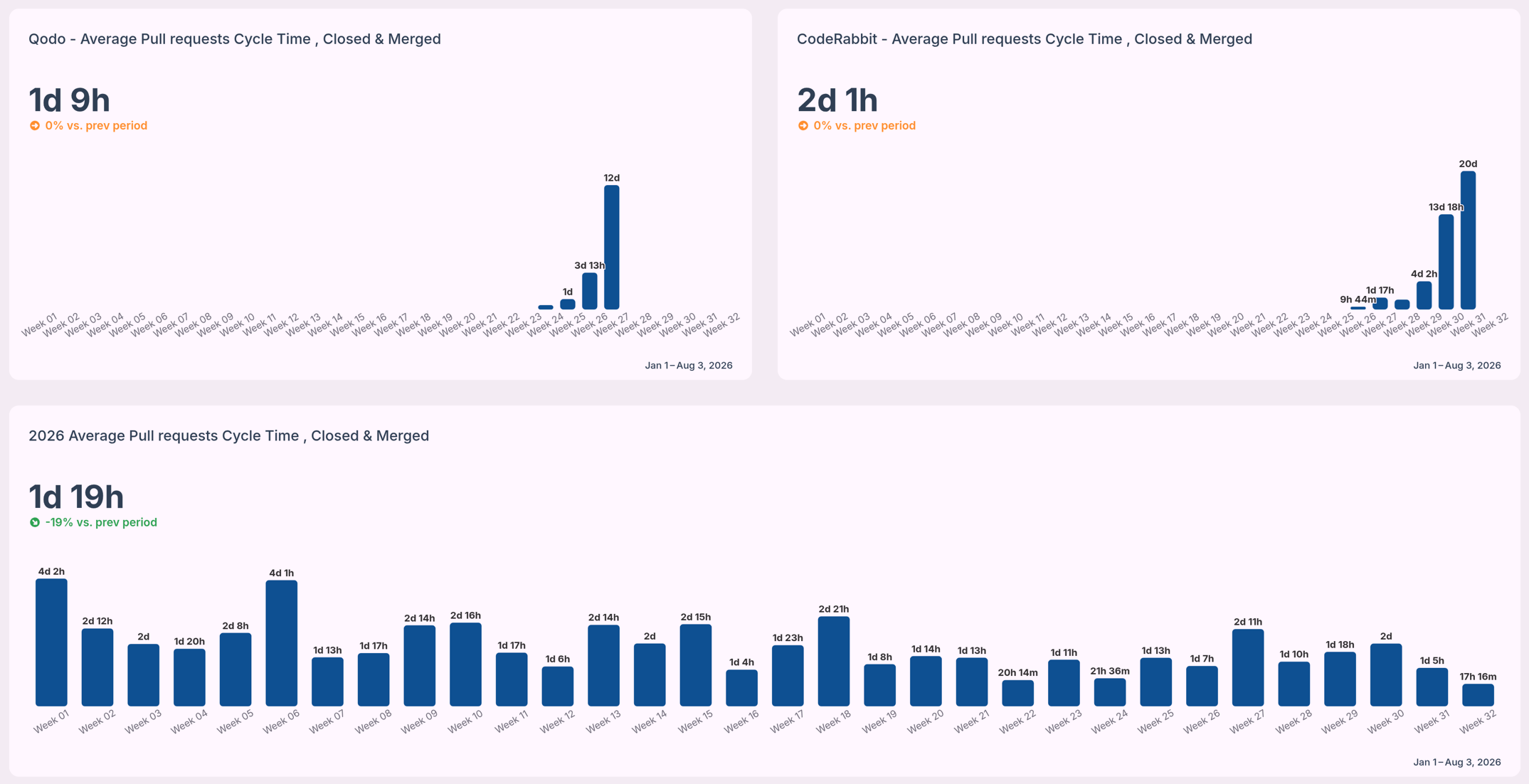
The team also measured how many times a pull request returned to the author for changes before approval.
Fewer review cycles can indicate less back-and-forth and lower review churn. The Qodo period showed fewer average review cycles than the CodeRabbit period.
This was useful evidence, although a full quality assessment would also need to consider defects, incidents, rollbacks, and escaped issues.
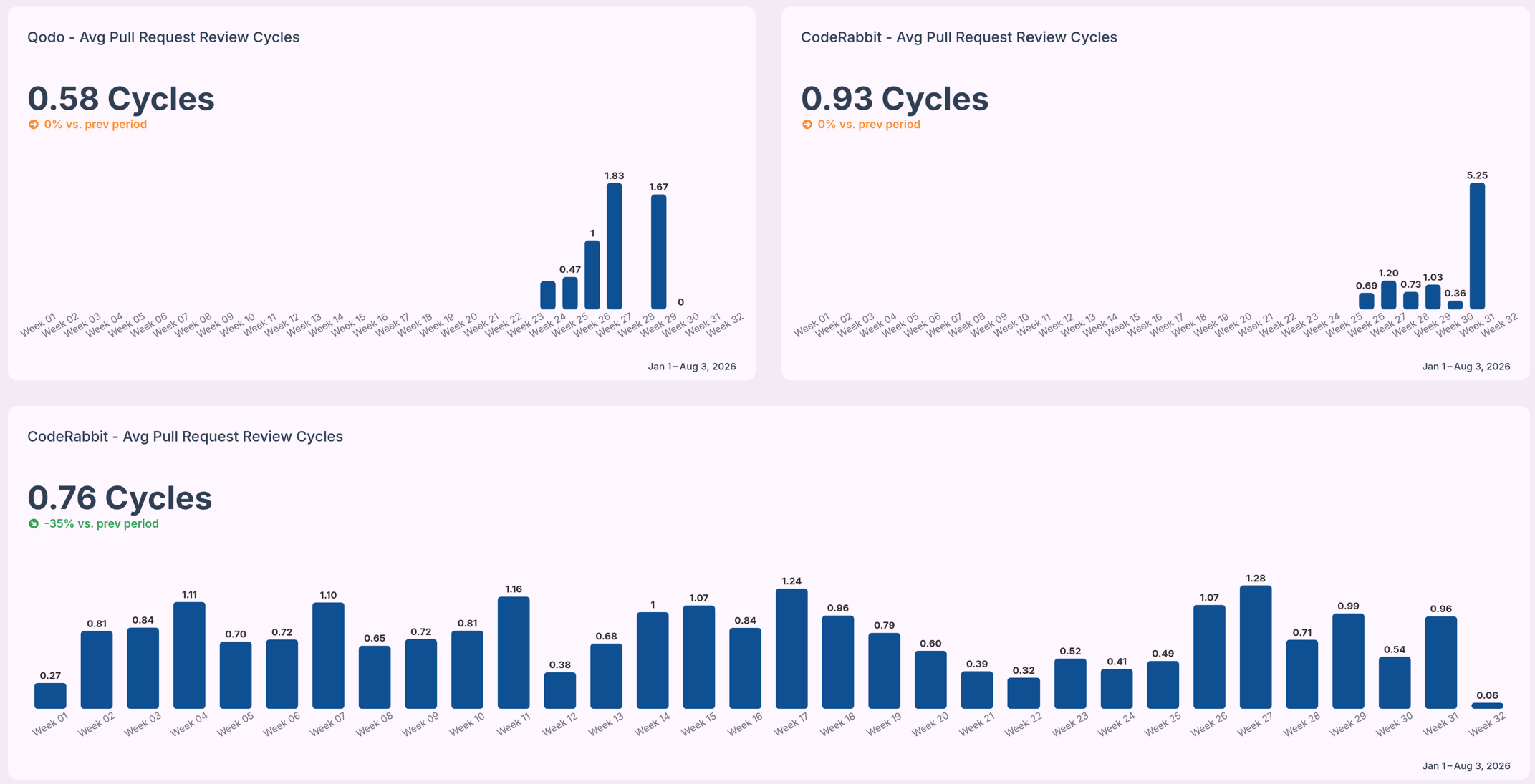
Overall cycle time shows that a difference exists. It does not explain where the delay occurred.
The customer therefore examined time spent in stages such as coding, waiting for review, active review, and merge.
This helped distinguish active work from waiting time and showed whether differences came from review pickup, review complexity, or later workflow stages.
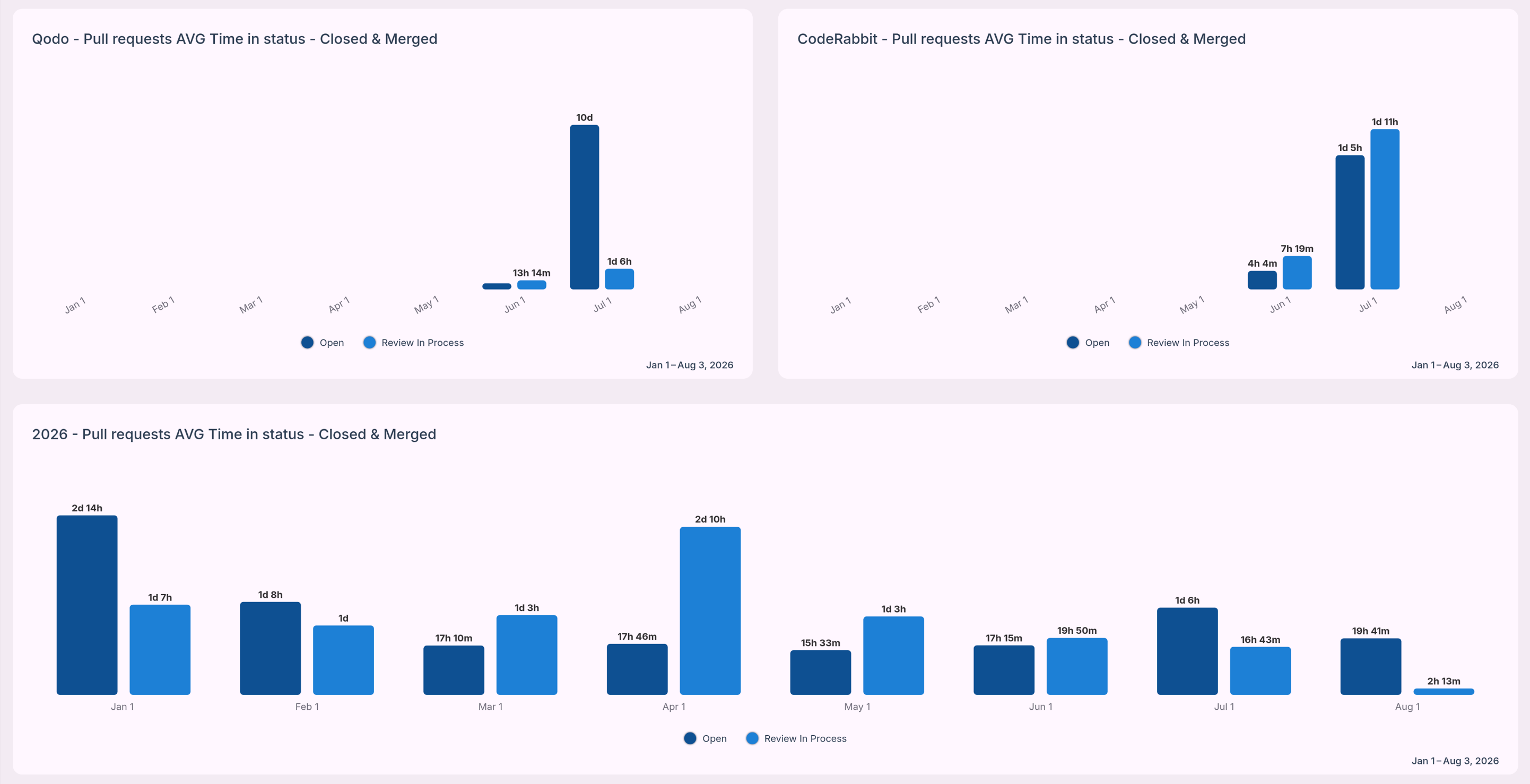
Across the metrics selected for the proof of concept, the Qodo evaluation period showed stronger results than the CodeRabbit period.
The Qodo period recorded:
These results gave the customer a concrete basis for the selection decision.
The team was no longer deciding only which product looked more capable in a demonstration or which tool developers preferred. They could compare how each vendor affected real work inside their engineering system.
The result should remain specific to this customer. It does not establish a universal benchmark for either vendor. The outcome reflected the organization’s developers, repositories, processes, work mix, and evaluation periods.
That limitation does not weaken the analysis. It is what makes the result useful.
The customer needed to know which vendor performed better in its own environment.
A useful AI vendor POC should answer two questions: “Which tool did developers prefer?” and “What changed in the delivery system when the tool was introduced?”.
To build a stronger evaluation:
No single metric should decide the outcome.
A tool may reduce review time while increasing quality risk. Another may receive strong developer feedback but show little measurable effect on delivery. A complete evaluation balances operational outcomes with usability, risk, and cost.
AI engineering vendors should be evaluated on more than features, adoption, and perceived time savings.
The real question is whether a tool improves the flow, quality, and predictability of software delivery.
By testing Qodo and CodeRabbit with a defined group of developers, applying consistent operational metrics, and using TargetBoard Saved Filters to accelerate the analysis, this customer turned a typical POC into a more defensible purchasing decision.
The result was not simply another dashboard. It was a clearer understanding of what changed, where the differences appeared, and which vendor produced the stronger outcome for that organization.
TargetBoard helps engineering leaders compare vendor performance using operational data from their own teams and workflows.
See how TargetBoard can help you build a more objective, repeatable vendor evaluation process.
An ai code review is the process of using Large Language Models to automatically analyze pull requests. These tools scan source code analysis outputs to detect syntax errors and suggest refactoring options before a human reviewer steps in. They excel at identifying boilerplate code issues and enforcing standard automated linters. But they struggle with cross-service dependencies and complex business logic constraints.
The most effective engineering teams treat an ai code reviewer as a high-speed assistant rather than an autonomous decision-maker. AI models lack the operational context to make final architectural decisions. They can't negotiate API contracts or understand why a specific workaround exists for a legacy system.
That means a human-in-the-loop review remains absolutely critical. You use the AI to clear out the noise of code formatting and basic threat detection, so your senior engineers can focus their cognitive energy on system design and business logic.
A major limitation of current AI tools is their reliance on file-level analysis. An AI assistant might review a single pull request and confirm the syntax is perfect. Yet that same code might break cross-service dependencies three layers deep in your application.
This happens because AI context windows face strict VRAM limits and memory constraints, preventing them from holding your entire codebase in memory at once. Trusting AI file-level analysis without verifying the broader repository context is a common mistake that leads directly to architectural drift. Your delivery pipeline must connect code changes to system-wide impacts to prevent this risk.
Yes, a code review ai is highly accurate when evaluating isolated syntax and standard formatting rules. Conversely, accuracy drops to near zero when evaluating complex logic or proprietary frameworks. This drop in precision introduces high rates of false positives and AI hallucinations into your pull requests.
Consider a common scenario where an AI tool successfully identifies a missing variable declaration but completely misses a breaking change in your core payment processing logic. The AI then floods the pull request with dozens of comments about stylistic formatting. Developers end up arguing with an AI bot in the comments over subjective syntax choices, creating massive review churn.
This noise creates an overwhelming backlog for human reviewers and actively slows down sprint velocity. Developer overreliance on these tools compounds the problem. Junior engineers might blindly accept AI suggestions without understanding the underlying code, injecting hidden technical debt into the system. You must measure this friction continuously to ensure the tool is actually accelerating your workflow rather than just generating noise.
Selecting the best ai code review tools requires matching the platform's core capability to your specific workflow bottleneck. You must differentiate between tools that generate code, platforms that scan for vulnerabilities, and systems that measure the systemic impact of those changes.
Tools like CodeRabbit and Qodo focus heavily on pull request summarization. They read the diff and generate a plain-language summary of the changes, so human reviewers can grasp the intent faster. This approach often improves initial time-to-merge metrics for simple tasks.
But open source ai code review tools in this category can struggle when deployed on massive enterprise monorepos. The sheer volume of interconnected files overwhelms the model. This leads to generic summaries that fail to capture the actual architectural impact of the change.
GitHub Copilot and similar IDE extensions operate directly where developers write code. These tools use agentic workflows to suggest entire functions as the developer types. They are incredibly effective at reducing the time spent writing boilerplate syntax.
They operate with a limited view of the broader system. A native extension might suggest a highly efficient sorting algorithm, yet it can't verify if that logic violates broader API contracts established by another team. Human reviewers must still validate those systemic connections.
Enterprise platforms like SonarQube and Greptile focus on strict CI/CD integration. They run deep static analysis to ensure your codebase maintains OWASP compliance and prevents known vulnerabilities from reaching production. These tools are non-negotiable for teams operating in highly regulated environments.
A major consideration in this category is data sovereignty. Sending proprietary enterprise code to external models for security scanning introduces compliance risks. You must configure these tools to ensure sensitive data remains within your controlled infrastructure.
Adopting ai powered code review tools frequently increases raw output while secretly damaging delivery predictability. You need a way to measure this friction. TargetBoard is an agentic operational intelligence platform that helps leadership teams understand how execution is performing, why it is changing, and how to respond.
TargetBoard connects data across company systems and uses domain-expert AI agents to understand workflow bottlenecks. It acts as the essential operational intelligence layer that shows you if your AI coding tools are actually improving sprint velocity or just creating massive review churn.
Implementing ai code reviews requires strict boundaries. You must configure the tool to handle objective rules while reserving subjective architectural decisions for human engineers. If you fail to set these boundaries, the AI will argue with your developers over code formatting and stylistic preferences.
This friction causes massive review churn and slows down your entire pipeline. You must structure the workflow to prevent this noise.
You must map exactly where the AI intervenes in your Software Development Lifecycle. The AI should run its analysis immediately upon pull request creation. It scans for syntax errors, basic code smells, and formatting violations.
The developer resolves these objective flags before a human reviewer is ever assigned to the pull requests. This sequence ensures your senior engineers only spend their time reviewing complex logic and system architecture.
You must train your AI tools using custom rule files specific to your repository. This step prevents the AI from suggesting changes that violate your internal business logic constraints. You can configure the tool to enforce DRY principles and flag code duplication automatically.
The interaction between these custom rule files, the model's context windows, and your code repositories determines the success of the tool. A well-configured rule file reduces false positives and ensures the AI only surfaces actionable insights.
You can't manage what you don't accurately measure. Relying on basic productivity metrics like lines of code written will mislead your leadership team. According to the 2023 DORA Report, true delivery predictability matters far more to business outcomes than raw development speed. You must measure if your ai code review tools are actually accelerating delivery or just shifting the bottleneck.
TargetBoard provides this critical measurement layer. It tracks the difference between AI-generated output and human review times. If an AI tool increases output by 40 percent but causes pull requests to sit in review for three extra days, your actual sprint velocity decreases. TargetBoard exposes these hidden workflow bottlenecks, so you can adjust your strategy based on objective operational intelligence rather than intuition.
The primary value of an AI code review tool is workflow efficiency, not replacing human architectural judgment. These tools are highly effective at clearing out boilerplate errors and enforcing basic code quality. Yet they introduce their own hidden complexities that require continuous systemic measurement.
According to 2024 GitHub Copilot research, AI assistants boost developer productivity by up to 55 percent. You must balance that speed with strict oversight to protect codebase maintainability and prevent the accumulation of technical debt. By running an operational intelligence layer alongside your AI tools, you can safely accelerate software delivery while maintaining complete confidence in your engineering metrics.
.png)
Value stream management (VSM) is an operational framework that connects business objectives to the software delivery lifecycle. The goal is to optimize how work moves from idea to production, helping leaders identify constraints and improve continuous flow. But tracking work is only the first step.
You must connect those tracking metrics to actual customer value and time-to-market outcomes. When you understand how value flows through your organization, you can stop reacting to delayed releases and start proactively removing the barriers that slow your teams down.
To build a reliable value delivery pipeline, you need to understand the foundational rules of the methodology. These principles guide teams toward predictable delivery and continuous improvement.
Applying these concepts to engineering requires a hard look at how your teams actually work. You likely track engineering performance using standard indicators like cycle time, lead time, and deployment frequency. These numbers provide a baseline for your delivery speed.
But a dashboard showing a spike in lead time doesn't solve the underlying problem. You have to trace that metric back to the specific workflow behaviors causing the delay. This requires connecting data across your planning and code systems to see the reality of your operations.
Workflow friction often hides inside routine development tasks. Consider a scenario where your overall cycle time suddenly spikes by 40 percent. The dashboard flags the delay, but it can't tell you that three high-complexity pull requests have been sitting in the review queue for four days.
The code is written, yet cross-team dependencies and unclear ownership prevent anyone from merging it. This code review churn artificially inflates your cycle time metrics. The work itself isn't slow, but the system is blocked. Identifying these specific constraints allows you to clear the path rather than just asking teams to code faster.
Traditional organizations fund temporary projects, which naturally creates organizational silos. Teams assemble, build a feature, and then disband. This breaks execution alignment and leaves no clear owner for long-term maintenance or technical debt.
Modern value stream management requires a shift toward a product-centric model. You fund stable, cross-functional teams that own a specific product from end to end. This structure improves capacity allocation because you align your best engineers with long-term value delivery rather than temporary task lists. The result is a more resilient delivery engine that adapts quickly to market changes.
Implementing this framework requires a structured approach to analyzing your value streams. You need to connect resource planning directly to your value delivery pipeline. This ensures you are solving the right problems instead of just optimizing isolated tasks.
Value stream mapping is the diagnostic tool you use to visualize how work flows through your organization. Follow these four steps to build an accurate map:
To improve flow efficiency, you must identify where engineering effort goes to waste. Modern software leaders face specific capacity concerns that look very different from physical manufacturing. Here is how the classic seven wastes translate to software delivery.
You can map your workflows perfectly, but legacy tools often fail because they rely on metrics without context. You see cycle time shifting, but you can't explain why execution breaks down. According to a 2023 Gartner report on engineering operations, most leaders struggle because their operational data is trapped in data silos.
This forces executives to rely on subjective updates from managers instead of trusted system-level reality. Tracking metrics provides visibility, but it doesn't provide understanding. TargetBoard is an agentic operational intelligence platform that connects data across company systems, interprets performance through operational intelligence, and uses domain-expert AI agents to guide execution decisions.
This shifts your organization from reactively monitoring dashboards to proactively fixing workflow friction. You gain the power to make confident execution decisions based on reality.
Artificial intelligence code generation accelerates output, so it fundamentally alters how work flows through your system. But higher output often introduces hidden delivery risk. For example, artificial intelligence code frequently experiences higher code review churn than human-written code because it requires intense scrutiny to verify complex logic.
If you only measure output volume, you miss the bottleneck forming in your review stage. This hidden complexity slows down the entire pipeline and delays critical execution decisions.
Tracking DevOps Research and Assessment metrics is a good start, but it's only showing you the symptoms of an inefficient system. You need to diagnose the disease through root cause analysis to achieve predictable delivery.
A common mistake in engineering leadership is treating performance metrics as goals rather than lagging indicators of system health. According to the 2023 Forrester Report on software delivery, teams that focus purely on metric targets often sacrifice long-term stability. When you stop chasing numbers and start focusing on resolving the underlying workflow constraints, your delivery confidence naturally improves.
This operational shift connects daily engineering tasks directly to broader business outcomes. By treating visibility as a starting point rather than the finish line, you create a culture of continuous improvement that actually scales. Understanding your system gives you a clear framework for your next planning session or your next board meeting.
.png)
SDLC improvement is the practice of identifying and eliminating workflow bottlenecks across the software delivery lifecycle to increase speed and maintainability. Improving the software development lifecycle traditionally meant adopting continuous integration automation or refining Agile ceremonies.
Today, achieving true SDLC efficiency requires optimizing your end-to-end flow system by focusing on three core areas:
Continuous improvement now depends on treating the delivery pipeline as an interconnected system rather than isolated stages.
Engineering leaders often try to fix delivery delays by adding more continuous integration pipeline automation. They assume faster pipelines will naturally speed up releases, but this ignores the human workflow bottlenecks that actually dictate pace.
Modern software development methodologies now rely heavily on AI coding assistants. These tools allow developers to generate massive volumes of code instantly, which creates catastrophic hidden queues during the code review phase. Reviewers become overwhelmed, and this leads to AI-induced review saturation.
Focusing purely on pipeline automation means you miss the fragmented operational realities happening on the ground. A developer might mark a ticket as complete in Jira, while the actual pull request languishes in GitHub awaiting a senior engineer's approval.
This conflicting data creates a massive blind spot. Relying solely on tracking metrics in this environment leads to missed deadlines because the underlying coordination friction remains completely ignored.
Industry standards like DORA metrics and SPACE frameworks are highly effective at measuring the outcomes of software delivery performance and tracking developer productivity trends. They tell you your deployment frequency dropped or your lead time increased. But these are lagging indicators vs leading signals.
They show you what happened, so they can't explain why it happened or how to fix it. A dashboard might show a 40 percent drop in velocity. It won't tell you that three high-complexity pull requests are blocking your critical path. Frameworks provide signals, yet they don't provide the operational understanding required to make confident execution decisions.
The push for faster development cycles has driven massive adoption of AI tools. AI-generated code contributions often lack the broader architectural context of your system, and this accelerates the accumulation of technical debt.
Balancing code generation speed against long-term maintainability risks is now a primary executive responsibility. If you don't manage this balance, the hidden cost of faster coding will manifest as severe delivery drag down the line.
To improve SDLC process efficiency, engineering leaders must shift their focus from local pipeline metrics to global flow-system optimization. This means identifying workflow bottlenecks across the entire lifecycle rather than just accelerating the coding phase.
Improving SDLC practices requires treating the delivery pipeline as an interconnected system. You can't fix a stalled delivery by pushing developers to code faster when the real constraint sits in the review queue.
Implementing SDLC best practices historically meant adopting Agile methodologies to structure team ceremonies or introducing shift-left testing to catch defects earlier. But optimizing an end-to-end delivery flow requires a completely different approach to governance.
The five steps of process improvement for modern software delivery include baselining your delivery flow, unifying data silos, identifying hidden queues, mapping dependencies, and automating execution signals.
This specific sequence reduces coordination friction and provides the system-level visibility required to make confident execution decisions.
Start by measuring your current cycle time trends across the entire lifecycle because you need a factual baseline of your true delivery speed. You must track a feature from the initial commit all the way through the final deployment phase so you can measure future improvements accurately.
Data trapped in fragmented systems creates severe operational blind spots for leadership. You must implement Jira and GitHub integrations to connect planning data directly with actual code activity. Unifying these data silos ensures your reporting reflects reality rather than just manual ticket updates.
Work often stalls quietly between active development stages. You need to identify hidden queueing systems where code waits for manual approval. Tracking pull request (PR) churn and applying code review intelligence helps you pinpoint the exact workflow bottlenecks causing review saturation across your engineering teams.
A fast engineering team can still miss deadlines if they wait on external approvals. You must map cross-team dependencies to understand exactly where work gets blocked in the broader organization. Resolving this coordination friction is critical for maintaining a predictable delivery cadence.
Manual reporting forces leaders to rely on stale data for critical resource allocation. You must automate actionable execution signals that flag high-risk pull requests and scope creep in real time. This proactive approach directly increases your overall delivery confidence and keeps execution aligned with planning.
Standard frameworks provide signals, but they fail to deliver operational understanding. To achieve predictable delivery, engineering executives need an operational intelligence layer that connects planning, code, and delivery systems seamlessly.
Agentic operational intelligence represents the modern standard for executive decision-making. TargetBoard is an agentic operational intelligence platform that helps leadership teams understand how execution is performing, why it is changing, and how to respond by deploying domain-expert AI agents to guide execution decisions.
You can't fix a bottleneck if you don't know it exists, so TargetBoard creates a unified operational model that removes the guesswork from engineering governance.
Scaling a development organization requires continuous alignment between planning and execution. You must prove engineering ROI by demonstrating that faster code generation translates into quality delivery. Tracking raw output is no longer sufficient for modern technology leadership.
This requires consistent post-deployment measurement to ensure that new AI tools don't degrade system stability. Leaders who govern their delivery systems proactively can scale their teams without accumulating hidden technical debt.
.png)
When one part of a system accelerates without upgrading the downstream constraints, the entire system degrades. This is the reality of the engineering management paradox. Developers use AI agents to write code at unprecedented speeds, so the volume of pull requests hits the review stage much faster than human reviewers can process them.
This AI-induced asymmetry breaks the flow of work. You get a massive backlog of unreviewed code, which causes pull request churn and delays. Leaders look at the high output metrics and assume teams are flying, but the delivery timeline keeps slipping.
Code generation volume scales exponentially with AI. Human review limits remain fixed by cognitive capacity and working hours. When you measure code generation volume without measuring the capacity to review it, you create a dangerous imbalance.
Review capacity saturation happens when reviewers are overwhelmed by the sheer size and frequency of pull requests. This forces developers to context-switch constantly, which degrades overall code quality and slows down the merge process.
Metric-gaming and output bias occur when teams are rewarded for merging code faster. Developers might use AI to generate boilerplate code just to hit velocity targets. This creates an illusion of increased developer productivity.
The flow of work matters more than the volume of work. Generating ten features that sit in a testing queue for three weeks doesn't help the business. True productivity requires moving code from a developer's machine into production without breaking the system.
The DevOps Research and Assessment frameworks provide valuable baseline signals for software delivery performance. They track deployment frequency and lead time for changes, but they don't explain why those metrics change.
If your cycle time or time to merge increases, traditional frameworks can't tell you if the delay is caused by complex AI-generated code or a breakdown in cross-team coordination. They measure the symptom, so they mask the underlying AI-induced risk. You need a deeper intelligence layer to understand the root cause of the delay.
Organizations adopting tools like GitHub Copilot or Tabnine often rely on developer sentiment and DevEx surveys to measure AI adoption. Developers often report feeling highly productive when using AI coding assistants. This qualitative data is useful for understanding team morale.
However, developer sentiment often contradicts objective operational signals. A developer might feel fast while writing code, but objective metrics might show that their pull requests require three rounds of rework. You must balance qualitative data vs. objective operational signals to see the true systemic impact.
Tracking the number of lines written or the volume of pull requests created is a flawed approach to measuring ai. Output volume / lines of code don't guarantee a stable delivery pipeline. You must measure the downstream delivery impact of that code.
Systemic execution tracking looks at the entire lifecycle. It measures how code generation affects QA testing, security reviews, and deployment reliability.
Software delivery is a manufacturing pipeline governed by global system constraints. You can apply academic queueing theory directly to the software delivery lifecycle to understand where work gets stuck. Little's Law dictates that the number of items in a system equals the arrival rate multiplied by the time they spend in that system.
AI coding assistants drastically increase the arrival rate of new code, so if the processing time at the review stage remains static, the queue length explodes. I recently watched an engineering organization celebrate a 40 percent increase in code generation, but their review queues expanded so fast that release confidence deteriorated entirely within two sprints.
You must track the exact moment your human reviewers become the bottleneck. Bottleneck detection and resolution require looking at wait states rather than active coding time. When review queues grow too long, developers switch contexts to start new tasks.
This creates severe coordination breakdowns across teams. A front-end team might generate UI components at record speed, yet they can't ship because the backend API review is stalled. I frequently have to reallocate senior engineering resources away from feature development specifically to unblock downstream bottlenecks caused by upstream AI acceleration.
AI often generates highly verbose code blocks that look syntactically correct but lack architectural coherence. Pull request complexity and size naturally inflate when developers rely heavily on generation tools. Reviewers then have to parse massive, unfamiliar logic structures.
This fundamentally alters your execution decisions and tradeoffs. A reviewer facing a 1,200-line AI-generated pull request will likely either rubber-stamp it or reject it entirely out of fatigue. Both outcomes carry a massive downstream delivery impact. Rubber-stamping introduces production defects, and blanket rejections destroy the flow of work.
Measuring ai code assistants requires a complete shift in perspective. You have to stop tracking the sheer volume of developer output. You must focus entirely on execution stability and the operational tradeoffs required to maintain a predictable pipeline.
This systemic AI measurement framework provides a structured model to evaluate how generated code interacts with your existing constraints. It helps you diagnose friction before it stalls your entire engineering department.
The first step is identifying where AI-induced asymmetry occurs between teams. Engineering leaders often make the mistake of using localized metrics out of context to claim an overall productivity increase while systemic stability degrades. One team might use AI to ship rapidly, but they overwhelm a dependent team that lacks the same tools.
You have to map cross-team dependencies to spot these imbalances. High AI output means nothing if cross-team coordination breaks down completely at the integration phase.
Objective measurement requires analyzing what happens after a developer opens a pull request. You must track rework patterns and pull request churn to see if the generated code actually survives peer review.
Direct observation across multiple engineering organizations shows a clear trend. Pull request churn often doubles for AI-generated code compared to human-written code. According to 2024 operations research on software pipelines, high rework rates are the leading cause of release confidence deterioration. You spend more time fixing generated logic than you would have spent writing it manually.
AI introduces a specific type of hidden complexity that easily evades initial code review. The code functions perfectly in isolated tests, yet it creates architectural friction that surfaces later. You have to track codebase health and technical debt to catch this early.
This hidden complexity acts as a long-term engineering drag. A function might be generated in seconds, but it might take hours to refactor when requirements change next quarter. You have to measure the cognitive complexity of the codebase over time to ensure you are not trading long-term maintainability for short-term speed.
Relying on isolated metrics to manage an engineering organization is a losing strategy. Industry frameworks provide useful baseline signals, but true understanding requires an agentic intelligence layer. You need a way to map local AI output directly to downstream workflow bottlenecks and review capacity saturation.
TargetBoard provides this system-level visibility by connecting planning, code, and delivery systems into a single trusted model. It moves you past passive reporting and subjective sentiment. By exposing hidden complexity and AI-induced risk before it slows the team down, TargetBoard gives you the objective operational signals needed to make confident execution decisions.
The current landscape forces engineering leaders into a difficult position. AI creates local acceleration but systemic instability. You can generate code faster than ever before, but that speed actively degrades your global system constraints and systems economics.
The organizations that benefit most from AI will not be the ones generating the most code. They will be the ones that best understand how AI reshapes review capacity, workflow coordination, system stability, and execution outcomes across the entire engineering organization.
.png)
Tracking sprint velocity on a dashboard gives you a false sense of control. These raw numbers easily become vanity metrics when they are disconnected from the actual engineering work. Teams quickly learn how to manipulate the dashboard when leaders only look at surface-level progress tracking.
This dynamic leads to inflated estimations just to show an upward trend. Forcing output to meet an arbitrary target is a dangerous anti-pattern that breaks your delivery process. It prioritizes speed over sustainable architecture and hides real bottlenecks.
Your data silos make this problem much worse. Jira might show a ticket is in progress, yet GitHub shows it's actually stalled in a complex review cycle. You must transition from simply observing disconnected data to actively interpreting it.
Executive leadership often treats KPIs as "truth," when in reality, they are merely symptoms. To lead effectively, you must understand where these metrics provide clarity and where they create dangerous illusions of progress.
Leaders often misinterpret flow as a measure of hustle, failing to see that these numbers are primarily indicators of workflow coordination failures.
Dashboards like burnups and flow diagrams are meant to expose workflow dynamics, yet they are often used merely for status reporting.
Speed without stability is just debt with a different name. Leaders who ignore quality signals in favor of flow metrics are inadvertently funding a future delivery collapse.
The surge in AI-assisted coding has introduced a dangerous era of false confidence for engineering leaders. On a standard dashboard, the acceleration looks spectacular: developers are shipping more code, more frequently, than ever before. However, this raw output masks a fundamental local productivity vs. system stability conflict. While an individual engineer’s throughput may spike, the systemic cost of managing that output often brings the entire delivery machine to a halt.
Traditional forecasting assumptions are breaking because they were built on the premise of human-scale output. AI-generated code creates a black box of hidden complexity that traditional metrics are not designed to flag until a deadline is already missed.
The following table highlights how AI-accelerated development creates review-system saturation and ultimately leads to delivery predictability collapse.
The most significant leadership risk is the false signal of "Green" metrics. A team might show record-breaking velocity, yet their actual progress toward a milestone remains stagnant. This is because AI can solve the "writing" problem while simultaneously exploding the "coordination" problem.
When your metrics focus on code production rather than workflow dynamics, you miss the moment your review pipeline becomes saturated and your senior engineers become overwhelmed. To maintain executive trust, leaders must look past the "AI-productivity" hype and measure the friction that high-speed output creates across the entire delivery lifecycle.
The primary challenge in modern engineering is no longer a lack of data; it is an interpretation gap. Frameworks like DORA or SPACE provide vital signals regarding speed and reliability, but they stop short of explaining the workflow behavior driving those numbers. They can tell you that cycle time has spiked, but they cannot articulate the underlying agile leadership blind spots or the hidden coordination failures that caused the shift.
To reclaim delivery trust, organizations need more than passive reporting. They require a layer of active interpretation that connects planning, execution, and delivery into a single, cohesive narrative. This is where TargetBoard shifts the paradigm – moving from raw data collection to coordinated decision-making.
TargetBoard is an agentic platform designed to expose the "why" behind your agile metrics. It unifies disparate data points into a trusted model, deploying domain-expert AI agents to translate fluctuating signals into actionable executive insights. By identifying the friction between conflicting operational realities, TargetBoard ensures that leaders are no longer reacting to dashboards, but actively steering their organizations based on a deep understanding of team dynamics.
Without a layer of active interpretation, leadership remains trapped in a cycle of reactive management. TargetBoard moves beyond the surface level to expose the systemic issues that standard frameworks miss:
By moving from measurement to interpretation, TargetBoard transforms agile metrics from a source of confusion into a foundation for delivery trust.
A sudden spike in cycle time is a symptom rather than the root cause. You must move past the surface data to uncover the actual bottlenecks and workflow friction. Here is how you can systematically diagnose the delay.
Driving sustainable execution is not a matter of following best practices, but of managing the inherent tensions within a high-pressure delivery environment. Leaders must actively navigate the following operational tradeoffs to ensure that engineering output translates into genuine business value.
Rewarding teams solely for the volume of closed tickets creates a dangerous incentive for local optimization. When throughput is prioritized over quality, teams often bypass rigorous testing or architectural standards to meet immediate quotas.
The most common agile leadership blind spot is the belief that capacity can be expanded through pressure alone. When teams are pushed beyond their sustainable flow, the first thing to suffer is maintainability.
A fast delivery process is a liability if it results in unstable code and a fractured user experience. Speed and stability are not mutually exclusive, but they do require a constant rebalancing of priorities.
Leaders often focus on the performance of individual teams, failing to see how those teams interact within the broader organization.
.png)
Quick Answer: Platform engineering is the discipline of designing and building self-service workflows to minimize cognitive load for developers.
At its core, an internal developer platform provides:
This approach allows stream-aligned teams to ship code faster without managing underlying operational complexities.
Engineering departments often confuse these roles, and defining clear boundaries is critical for resource allocation. Platform engineers build the paved roads, and DevOps philosophies influence how those roads operate. Without a dedicated platform team, developers often get stuck managing shadow operations instead of writing product code.
Treating the internal developer platform as a mandatory IT project often leads to poor adoption. The Platform as a Product mindset shifts this approach by treating developers as actual customers. Key characteristics include:
The demand for the platform engineering discipline has surged because organizations are struggling to manage the AI impact on software delivery. Developers use artificial intelligence to generate massive volumes of code rapidly, so raw output metrics look incredibly high. But this AI-generated code often introduces hidden complexity and technical debt into the codebase.
Reviewers are forced to spend days validating auto-generated logic. This creates massive workflow friction where code writing is fast but merging is painfully slow. Platform engineering teams are now essential for building the guardrails needed to manage this code surge without sacrificing delivery predictability.
When developers submit highly complex pull requests generated by artificial intelligence, human reviewers can't process them efficiently. This mismatch causes severe workflow bottlenecks that directly inflate cycle time. Pull request churn increases as reviewers request continuous changes to understand the automated logic.
This rework and duplication stall progress across the entire department. When one stream-aligned team gets stuck in an endless review cycle, cross-team dependencies break down. You can't forecast delivery timelines accurately when massive code outputs sit unmerged in fragmented systems.
Platform engineering directly shapes software delivery performance by removing the operational hurdles that slow teams down. A well-designed platform improves execution predictability by:
Golden paths are highly opinionated, supported approaches for building and deploying software. By standardizing these paved roads, platform teams achieve specific outcomes:
Security checks often act as a massive roadblock right before a product launch. Relying on manual approvals and traditional ticket ops forces developers to wait days for a security review, and this actively delays critical releases. Platform engineering solves this by embedding security and compliance guardrails directly into Continuous Integration and Continuous Deployment pipelines.
Developers receive immediate feedback on vulnerabilities while they are still writing code. This shifts security left and eliminates the late-stage friction that frustrates stream-aligned teams.
To evaluate delivery tradeoffs and manage resource allocation effectively, engineering leaders rely on a structured approach to building platforms. According to the Cloud Native Computing Foundation (CNCF) framework, a robust platform requires specific functional areas to operate smoothly^1. These six pillars form the foundation of a predictable delivery system.
A self-service portal provides a single interface for developers to access tools and documentation without filing IT tickets. This centralization reduces context switching so teams can ship features faster.
This pillar automates the setup of cloud resources and deployment environments. You must clearly delineate between basic infrastructure orchestration, which just spins up servers, and advanced operational intelligence, which monitors how efficiently those systems support delivery.
Standardized pipelines govern how code moves from a local commit to a production deployment. Platform teams build these automated routes to ensure every stream-aligned team follows the same reliable path to production.
Automated security checks run in the background to prevent vulnerable code from advancing. This eliminates the need for manual security reviews right before a critical launch.
Observability tools provide real-time visibility into application health and infrastructure performance. If a deployment causes an issue, the platform automatically flags the root cause so developers can resolve it immediately.
Platform teams must track adoption rates and identify workflow bottlenecks to continuously improve the platform. This data proves whether the internal developer platform is actually reducing friction or just shifting the burden to a different system.
Problem: CTOs and engineering leaders often rely on subjective developer surveys or standard engineering metrics to gauge success. These metrics provide useful signals, but they fail to explain why performance is changing or where hidden workflow bottlenecks live within data silos.
Solution: You need an operational intelligence layer to connect fragmented data and track the actual business impact of your platform. TargetBoard is an agentic operational intelligence platform that helps leadership teams understand how execution is performing, why it is changing, and how to respond.
It connects data across company systems and uses domain-expert artificial intelligence agents to guide execution decisions. Instead of looking at a static dashboard showing an unexplained drop in velocity, TargetBoard surfaces the exact workflow friction causing the delay so you can act immediately and improve system-level visibility.
Tracking engineering effectiveness requires a mix of output metrics and deep execution signals. You must measure how fast work moves and understand the context behind those movements to drive predictable delivery outcomes.
Standard DevOps Research and Assessment frameworks measure critical aspects of software delivery performance. They are excellent supporting signals for your organization. But they don't provide system-level visibility into why a team missed a deadline or why a specific repository is suddenly generating massive technical debt.
Consider the edge case where auto-generated code introduces hidden structural complexity. Standard delivery metrics entirely miss this technical debt until it causes a production incident months later. To truly measure engineering effectiveness, you must transition to operational intelligence that connects signals across planning, code, and delivery systems.
According to Gartner research, most software engineering organizations will establish platform engineering teams by 2026^2. But the platform engineering discipline requires internal cultural shifts and disciplined adoption. It's never just about purchasing software and hoping for a productivity spike.
Referencing Team Topologies provides a strong structural foundation for designing successful platform teams that interact smoothly with the rest of your engineering department^3. When you combine a well-structured platform team with proactive operational intelligence, you stop reacting to stale data. You gain the execution predictability needed to lead with complete confidence.
.png)
Leading and lagging indicators are the two primary data categories used to evaluate engineering performance. Lagging indicators measure the final results of a process after it concludes. Leading indicators measure the upstream activities and inputs that predict those future results.
Think of this dynamic through the classic windshield versus rearview mirror analogy because it clarifies how you use the data to make decisions. Leading indicators are forward-looking metrics that act as your windshield, helping you anticipate the road ahead. Lagging indicators are backward-looking metrics that serve as your rearview mirror, showing you exactly where you have been. You need both, so you can make accurate execution decisions.
You can quickly audit your current reporting dashboards to evaluate leading versus lagging indicators. Ask these diagnostic questions to determine if your data provides actionable insights or just a historical record:
Investopedia and standard corporate glossaries focus on marketing or sales data when defining leading and lagging indicators. Engineering executives need specific engineering performance metrics mapped to the software delivery lifecycle.
Lagging indicators confirm the final results of the software delivery lifecycle. They are essential for aligning engineering efforts with broader business outcomes. These metrics tell you if a project shipped on time or if a release met quality standards.
Platform engineering teams also track coincident indicators, which measure activity happening right now. The core value of a lagging indicator remains its definitive proof of past performance. Common examples include total bugs found in production and final release frequency.
Leading indicators highlight the friction points happening right now that will inevitably impact your final delivery metrics. These signals allow you to intervene early. If you track Pull Request size and complexity, you can predict which code reviews will stall.
High review churn acts as a clear warning sign, often predicting technical debt and poor code quality. Monitoring cross-team dependencies helps you spot coordination bottlenecks before they derail an entire release timeline. Managing these inputs gives you direct control over the eventual outcomes.
Standard measurement frameworks provide valuable signals about overall organizational health, but they lack the operational understanding needed to drive daily execution. CTOs and VPs of Engineering have experienced the frustration of presenting stalled delivery metrics to a board while their dashboard shows green across the board. Delivery can suddenly halt despite good past metrics because standard tools lack systemic visibility. They force you into a state of reactive management.
This gap becomes critical when teams introduce AI-generated code into their workflows. AI tools dramatically increase code output volume, which creates a false sense of speed. That sheer volume introduces hidden complexity and massive review bottlenecks that standard frameworks fail to catch until cycle time completely collapses. Output volume isn't the same thing as delivery predictability.
You can't manage a modern engineering organization by looking at outcomes alone. You must establish a clear cause-and-effect relationship between your daily engineering activities and your final business results.
Tracking both lead and lag indicators allows you to perform root cause analysis in real time. If you see a predictive signal flashing red, you can course-correct before the sprint fails. According to the 2023 Forrester Research report on engineering operations, teams that actively monitor upstream workflow friction achieve significantly higher delivery predictability than teams tracking only final deployment rates.
Engineering executives know they must track predictive signals to prevent delivery failures. The reality is that manually piecing together fragmented data across tools like Jira and GitHub to compare lagging vs leading indicators is completely unsustainable. You often end up with conflicting signals where Jira shows a project on track while GitHub shows massive review delays.
To truly act on predictive signals, leaders need a system that automatically connects cross-system workflow behavior to delivery metrics to explain why performance is changing. This requires an evolution from passive observation to active intervention.
By unifying this fragmented data, an operational intelligence layer gives you the context needed to make confident execution decisions. You stop relying on stale reports and start managing the actual flow of work.
Understanding the difference between outcome metrics and predictive signals changes how you run your engineering organization. You gain the ability to measure and manage performance based on operational reality rather than retrospective reporting.
This approach gives you a clear framework for technical risk mitigation and smarter resource allocation. By monitoring workflow friction early, you protect your long-term maintainability rather than waiting for a North Star Metric to drop at the end of the quarter. You stop reacting to missed deadlines and start actively guiding your engineering systems toward predictable and sustainable delivery.
.png)
Engineering analytics is the practice of analyzing data from the software development pipeline to understand and improve software delivery performance. It connects fragmented data points across issue trackers and code repositories to give leaders systemic visibility.
The goal is to move beyond simply measuring output and start governing the entire delivery system. This continuous evaluation of engineering metrics helps organizations identify bottlenecks and align daily work with strategic business outcomes.
Search results often mix these two distinct concepts. Analytics engineering is a specific job title within the modern data stack. These professionals build and maintain the data pipelines that data scientists use for business intelligence.
Engineering analytics is an operational discipline used by technical executives. VPs of Engineering and CTOs use this discipline to monitor workflow bottlenecks and maintain delivery predictability.
Imagine staring at a dashboard on Friday afternoon during a critical delivery cycle. Deployment frequency looks healthy, yet lead time for changes has doubled. Your engineering managers spent hours dealing with manual reporting overhead to build this view, but the dashboard can't explain the root cause of the delay.
This highlights the fundamental problem with passive reporting. Dashboards give you metrics without context. They show a snapshot of past performance but offer zero actionable insights to resolve the workflow friction. Analytics requires an operational intelligence layer to interpret those signals and guide your response.
Understanding the evolution of data maturity helps clarify why dashboards fall short. The industry breaks analytics into four operational stages.
AI coding tools are fundamentally changing how work is produced. They accelerate initial output, so developers ship more volume in less time. Traditional developer productivity frameworks look at this spike in velocity and assume the system is highly efficient.
But this volume introduces massive hidden complexity. The difference between AI-generated code vs. human-written code often shows up during the review phase. An AI tool might write a feature in ten minutes, but that high-complexity pull request can sit in review for four days. Human reviewers struggle to validate the dense logic, creating severe workflow friction.
The deployment metrics look temporarily inflated, yet technical debt quietly accumulates in the background. The delivery system slows down over time as developers spend hours untangling complex PRs instead of writing new features. You can't manage this new reality with basic dashboards because they measure the speed of creation while completely missing the downstream cost of code review.
The core issue is no longer a lack of visibility. Jira and GitHub provide enough raw data to achieve system-level visibility, yet engineering leaders still lack objective understanding. You need a reliable way to turn conflicting metrics into clear execution decisions without relying on manual analysis or guesswork.
TargetBoard is an agentic operational intelligence platform that connects data across company systems, interprets performance continuously, and uses domain-expert AI agents to guide execution decisions. It automatically interprets fragmented data across your tools to uncover hidden issues like PR churn.
This intelligence layer surfaces decision-ready insights for leaders. You can restore delivery predictability and identify bottlenecks objectively, allowing your teams to stop reacting to stale reports and start addressing workflow friction as it happens.
VPs of Engineering mistakenly treat deployment metrics as a complete measure of developer productivity rather than just a starting signal. According to the 2023 DORA report, elite performing teams prioritize delivery predictability and system reliability alongside raw speed. Frameworks like DORA metrics and the SPACE framework provide valuable benchmarks for these outcomes.
But these frameworks don't provide systemic understanding. They tell you that a metric shifted, yet they can't isolate the root cause behind the shift. You need an active intelligence layer to connect those framework signals to actual workflow behavior.
Real execution decisions happen when you connect data to specific workflow bottlenecks. Consider a sprint where cycle time spikes by 40 percent. A basic dashboard simply reports the delay, but operational intelligence reveals the actual mechanics.
According to 2023 industry benchmarks from LinearB, pull request review time accounts for 70 percent of delivery delays. In this scenario, three high-complexity pull requests sat in review for over four days due to cross-team dependencies, directly causing that 40 percent cycle time spike. Identifying pull request (PR) churn at this granular level allows you to reallocate senior engineers to clear the backlog immediately.
Selecting the right platform requires evaluating how well it moves your organization from reactive reporting to proactive governance. Modern engineering analytics systems and engineering analytics tools fall into three primary categories. You need a unified source of truth to manage complex delivery pipelines effectively.
Relying on output metrics alone creates a false sense of security, especially when AI tools inflate short-term velocity. True organizational improvement requires understanding how work flows through your entire delivery pipeline. Shifting from passive dashboards to operational intelligence gives you the context needed to drive execution alignment.
Understanding these patterns gives you a clear framework for your next resource allocation decision. You can stop reacting to delayed reports and start managing delivery predictability proactively.
.png)
The dark side of measurement emerges when isolated metrics create a false sense of security. Teams naturally optimize for what leadership measures, so they inflate output numbers while ignoring the underlying bottlenecks that dictate true delivery speed.
I spoke with a VP of Engineering last quarter who experienced this firsthand during a major platform overhaul. Their DORA metrics looked perfect, and deployment frequency was at an all-time high. But the reality on the ground was a complete disaster.
The team was merging hundreds of tiny pull requests to keep velocity metrics green, while high-value features were trapped in endless review churn. This is the classic trap of watermelon dashboards. The reports look green on the outside, but they hide a deeply red execution reality on the inside.
A 2023 McKinsey analysis on developer productivity confirms that relying solely on isolated output metrics often masks the accumulation of technical debt, leading to accidental metric manipulation. Isolated metrics hide the actual complexity of the work, leading to missed deadlines.
Integrating data streams actively prevents these operational blind spots. A unified approach delivers specific advantages for leadership:
Enterprise software companies try to solve this trust crisis by purchasing a new visualization tool or building a massive data lake. They assume that routing all their disparate data into a single dashboard will magically create alignment.
But combining data is an institutional governance problem, not a simple routing issue. According to a 2022 Gartner study, nearly 60% of data integration projects fail to deliver business value because they focus purely on data movement rather than operational context.
Standard master data management (MDM) and data mining practices are technically sound, yet they fail to provide decision-grade reliability. A data warehouse can tell you that a Jira ticket took ten days to close.
It can't tell you that the ticket was delayed because AI-generated code introduced architectural complexity requiring three rounds of senior developer review. If your metrics don't reflect actual engineering workflows, your BI tools can't guide execution.
Building basic ETL pipelines only gives you faster access to the same disconnected metrics. True organizational alignment requires a system that interprets how a decision in one department impacts the delivery speed of another.
To make data-driven decisions, leaders must integrate critical business streams across the entire development lifecycle. The most common KPI data sources include project management platforms, code repositories, and customer support desks.
When you keep these disparate data sources isolated, they inherently conflict. Connecting them is the only way to build the contextual understanding required to spot trends before they derail a project. Integrating data streams across these three pillars provides a complete view of organizational performance.
Tools like Jira and Asana track the planned work and capacity allocation for your teams. They show you what engineering execution should look like in theory. But these systems often fail to capture hidden workflow bottlenecks, so leaders must cross-reference this planning data with actual code delivery metrics.
Platforms like GitHub house the actual reality of your software delivery. This is where you see the impact of AI-accelerated output and the hidden complexity it often introduces. Monitoring pull request size and review churn here reveals the technical debt accumulation that project management tools miss entirely.
Systems like Salesforce and Zendesk capture the downstream impact of your engineering decisions. They highlight operational friction and customer-reported defects. Relying on these tools in isolation creates attribution flaws, so you must connect support ticket volume back to specific code deployments to ensure accurate data validation.
Executives are tired of acting as human data routers. You spend hours interpreting disconnected charts just to guess why a project missed a deadline. To achieve true measurement authority, you must shift from passive dashboards to an active operational intelligence layer.
Implementing automated multi-source tracking provides distinct advantages for leadership teams:
Passive tools force you to interpret the data yourself. Modern execution requires systems that explain why the data is changing.
TargetBoard is an agentic operational intelligence platform that creates an intelligence layer between data systems and execution. It connects data across company systems, interprets performance continuously, and uses domain-expert AI agents to guide execution decisions. We don't just measure engineering performance. We explain why it's changing.
Mapping a single business outcome across multiple software systems proves the value of cross-system interpretation. Leaders can't fix a delivery bottleneck by looking at one tool in isolation. You must trace the delay directly to its root cause across your entire architecture to understand the real execution problem.
Consider a sudden spike in cycle time for a critical feature release. If you only look at your project management tool, you see a stalled ticket. That tells you nothing about the actual problem. But applying a cross-system framework makes the reality immediately clear.
First, your planning system flags the delayed initiative. Next, your code repository reveals that AI-generated code introduced massive structural complexity, resulting in high review churn. Finally, your delivery system shows that this specific complexity is causing deployment failures. Connecting KPIs from different data sources transforms a vague delay into a precise execution problem you can solve.
Achieving organizational alignment requires moving from disjointed reporting to a unified system that governs how performance is interpreted across the entire enterprise. You need a structured approach to build delivery confidence and establish a single source of truth. Keep in mind that frameworks like DORA or SPACE only provide signals rather than actual understanding.
.png)
Data paralysis in engineering occurs when leaders can't make confident execution decisions because they are overwhelmed by fragmented performance metrics. This condition isn't caused by a lack of visibility. The root cause is an overwhelming volume of disconnected information.
Modern software teams generate terabytes of data across planning, code, and delivery systems. Research from IDC predicts global data creation will reach 181 zettabytes by 2025, and engineering organizations feel this zettabytes and data volume pressure daily.
When leaders stare at dozens of charts that don't explain why numbers are changing, they experience an actionability gap. This information overload forces teams into reactive management rather than proactive decision-making.
Decision paralysis is a direct symptom of operational distrust caused by fragmented data. Engineering leaders experience this as a systemic decision failure. You look at Jira and see tickets closing rapidly, so you assume the team is healthy.
You then look at GitHub and see a bottleneck of unmerged code. These conflicting signals completely undermine the credibility of your reporting. This lack of context inevitably leads to forecasting collapse.
You can't predict delivery timelines when your underlying data is untrustworthy. Board members press for delivery dates, and you are forced to rely on intuition instead of objective execution signals. The organization then slips into reactive management, responding to emergencies rather than guiding execution.
A clear example of analysis paralysis happens during code review bottlenecks. A VP of Engineering sees cycle time increasing steadily over three sprints. Legacy dashboards highlight the delay but offer no root cause.
This forces the leader to waste days manually digging through pull requests, trying to determine if the issue is individual developer performance or a broader systemic problem. In reality, AI-generated code has introduced hidden complexity, leading to a 30% increase in PR churn and review cycles.
Because the dashboard can't connect code complexity to delivery delays, the leader freezes. They can't confidently allocate resources to fix the workflow bottlenecks or address the underlying cross-team dependencies.
The core issue driving execution confusion is the reliance on legacy dashboards. These tools were built to measure output, so they present point-in-time reporting. They show you what happened yesterday but fail to explain why it happened or what will happen tomorrow.
This creates a data complexity pitfall where leaders track misaligned KPIs that don't reflect actual system health. When you rely on untrustworthy data, you can't make fast execution decisions. The architectural shift required is moving from passive measurement to active understanding.
Escaping data analysis paralysis requires shifting your focus from gathering metrics to applying strategic goals and filters. You can't measure every data point in your engineering organization. When you attempt to track everything, you lose the ability to understand execution tradeoffs clearly.
Leaders must filter out the noise to accurately assess delivery risk and predictability. This structural shift allows you to move from passive observation to confident decision-making.
Problem: Leaders are overwhelmed by metrics that don't influence engineering capacity allocation. Tracking data without a specific goal creates confusion rather than clarity.
Solution: Define the exact parameters you need before you open a reporting tool so you don't get distracted by irrelevant data. Then, limit your options to objective execution signals because they directly inform your next move.
Outcome: You restrict your focus to actionable insights and eliminate irrelevant data. You can then allocate engineering resources based on actual workflow constraints rather than vanity metrics.
The fear of error paralyzes teams, so leaders delay critical choices while waiting for absolute certainty. This creates severe decision-making delays that delay the entire delivery pipeline.
You must accept that perfect is the enemy of good in software engineering. A strong directional signal is far more valuable than a delayed perfect metric. When you prioritize action, you restore momentum and prevent bottlenecks from compounding.
Traditional dashboards fail because they rely on manual reporting overhead and often trigger the Hawthorne Effect, where developers change behavior simply because a metric is tracked. This creates a false sense of security.
According to a 2023 Forrester Report, AI code assistants significantly increase code volume, yet they require stricter quality gates to prevent risk. AI-driven complexity demands a system that actively interprets performance rather than just visualizing it.
Buying more visualization tools to solve a data problem is a common software anti-pattern. Leaders often assume that a better chart will finally provide clarity, but they soon realize the limitations of data visualization.
Measurement isn't inherently bad, but it is insufficient without context. You escape the data daze by implementing a system that tells you why performance is changing.
When you connect planning data to actual code delivery, you build a resilient operational foundation. You stop reacting to shifting numbers and start driving predictable, confident execution.
In today's fast-paced business world, choosing the right technology solutions and vendors is more than just a matter of preference; it's a strategic decision that can significantly impact an organization's flexibility and growth. A critical factor in this decision-making process is the concept of vendor lock-in—the extent to which a company is tied to a specific vendor or product and the associated costs and complexities of switching to a different solution.
Many technology products today come with integrated Business Intelligence (BI) and reporting features. While these functionalities often seem beneficial at first glance, they can, paradoxically, limit a company's agility. By creating a dependency on these built-in tools, vendors make it challenging for companies to move away from their products, thus increasing the stickiness and dependency.Furthermore, the integration with third-party tools often involves pulling data into proprietary BI and analytics solutions, further entrenching organizations into the vendor's ecosystem. This integration can appear advantageous, but it often leads to a complex web of dependencies that can be costly and time-consuming to untangle.
TargetBoard offers a transformative solution to this common dilemma. By connecting to third-party systems, TargetBoard extracts and models data into our proprietary semantic layer. This process helps customers decouple their critical data from source systems, significantly reducing the risk of vendor lock-in.
1. Reduced Re-platforming Costs:
By simplifying the process of migrating data and systems, TargetBoard decreases the overall expenses associated with re-platforming projects.
2. Enhanced Data Lineage and Continuity:
Our approach ensures better tracking of data origin, movement, and transformation, providing businesses with a clearer understanding and greater control over their data assets.
3. KPI Stability and Reliability:
One of the most significant advantages of using TargetBoard is the assurance that key performance indicators (KPIs) remain consistent and reliable, even when there are changes or upgrades to underlying tools. This stability is crucial for businesses that rely on data-driven decision-making.
4. Superior Analytical Capabilities:
Beyond just preserving existing functionalities, TargetBoard enhances the analytical capabilities available to businesses, often surpassing what is offered by the source systems themselves.
TargetBoard stands out for its effortless integration, regardless of your stage in the vendor migration process. Whether you're planning a transition or have already moved, incorporating TargetBoard is straightforward, risk-free, and requires minimal effort. Our platform is tailored to blend into your existing systems smoothly, allowing you to quickly benefit from uninterrupted KPI continuity, without disrupting your business operations.
In conclusion, TargetBoard empowers organizations to take control of their technology choices. By providing a way to easily extract and utilize data independent of the underlying systems, we help businesses avoid the pitfalls of vendor lock-in, ensuring they remain agile, data-savvy, and competitive in an ever-evolving market landscape.

.webp)